 Back
BackStep-by-Step Guidance for FIN 301 Financial Management Exam I
Study Guide - Smart Notes
 Tailored notes based on your materials, expanded with key definitions, examples, and context.
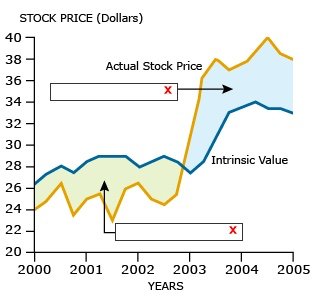
Q5. Based on your intrinsic value calculations, indicate on the chart where the stock is overvalued vs. undervalued. In which region is the company more likely to receive a hostile takeover bid? Why?
Background
Topic: Stock Valuation and Corporate Takeovers
This question tests your understanding of the relationship between a stock's market price and its intrinsic value, and how this affects the likelihood of a hostile takeover.
Key Terms:
Intrinsic Value: The true, underlying value of a stock based on fundamental analysis.
Market Price: The current price at which the stock is trading in the market.
Hostile Takeover: An acquisition attempt by an outside party, often when the company is undervalued.
Overvalued: When the market price is above the intrinsic value.
Undervalued: When the market price is below the intrinsic value.
Step-by-Step Guidance
Examine the chart and identify the periods where the actual stock price is above the intrinsic value. These periods represent overvaluation.
Identify the periods where the actual stock price is below the intrinsic value. These periods represent undervaluation.
Consider why a hostile takeover is more likely when the stock is undervalued. A potential acquirer can buy the company at a price lower than its intrinsic value, making it a profitable opportunity.
Look for the region on the chart where the actual stock price is consistently below the intrinsic value. This is where a hostile takeover bid is most likely.
Try solving on your own before revealing the answer!
Final Answer:
The stock is overvalued when the actual stock price is above the intrinsic value (right-hand side of the chart), and undervalued when the actual stock price is below the intrinsic value (left-hand side of the chart). A hostile takeover bid is more likely in the undervalued region because the acquirer can purchase the company for less than its intrinsic value, potentially earning a profit by bringing the market price in line with intrinsic value.
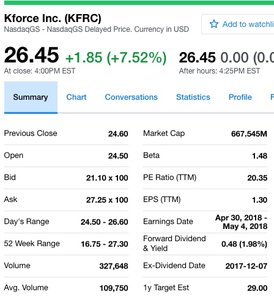
Q6. Based on the given stock quote for Kforce Inc. (KFRC), indicate and explain if the stock had an active or inactive day. Also, you would like to buy 200 shares of Kforce. According to the quote, how much will you pay?
Background
Topic: Stock Quotes and Trading Activity
This question tests your ability to interpret a stock quote and determine trading activity, as well as calculate the cost of purchasing shares.
Key Terms:
Volume: The number of shares traded during the day.
Average Volume: The average number of shares traded per day.
Ask Price: The lowest price a seller is willing to accept for a share.
Bid Price: The highest price a buyer is willing to pay for a share.
Step-by-Step Guidance
Compare the day's volume to the average volume. If today's volume is significantly higher, the stock had an active day.
Check the ask price to determine the cost per share for buying.
Multiply the ask price by the number of shares you want to buy to estimate the total cost.
Consider the availability of shares at the ask price. If fewer shares are available than you want to buy, you may need to pay a higher price for the remaining shares.
Try solving on your own before revealing the answer!
Final Answer:
The stock had an active day because the volume (327,648) is about three times the average volume (109,750). To buy 200 shares at the ask price of $27.25, you would pay $5,450, but only 100 shares are available at that price, so you may need to pay more for the remaining shares.
