 Back
BackStep-by-Step Guidance for Financial Accounting and Managerial Accounting Study Questions
Study Guide - Smart Notes
 Tailored notes based on your materials, expanded with key definitions, examples, and context.
Q1. Indicate whether each concept is a function of financial accounting or managerial accounting:
Background
Topic: Financial vs. Managerial Accounting
This question tests your understanding of the differences between financial accounting (external reporting) and managerial accounting (internal decision-making).
Key Terms:
Financial Accounting: Focuses on providing information to external users (e.g., stockholders, creditors).
Managerial Accounting: Focuses on providing information to internal users (e.g., managers, employees).
Step-by-Step Guidance
Read each concept and identify whether it relates to internal or external decision makers.
Recall that managerial accounting is primarily for internal users, while financial accounting is for external users.
Consider if the reports are used for stockholder decisions (external) or management decisions (internal).

Try solving on your own before revealing the answer!
Final Answer:
Accounting information used by internal decision makers: Managerial Accounting. Reports help stockholders make decisions: Financial Accounting.
Managerial accounting is for internal use, while financial accounting is for external use.
Q2. Calculate cost of goods sold for the year given inventory and manufacturing costs.
Background
Topic: Cost of Goods Sold (COGS) Calculation
This question tests your ability to calculate COGS using inventory and manufacturing cost data.
Key Formula:
Step-by-Step Guidance
Identify the values for beginning finished goods inventory, cost of goods manufactured, and ending finished goods inventory.
Plug these values into the COGS formula above.
Subtract the ending inventory from the sum of beginning inventory and cost of goods manufactured.
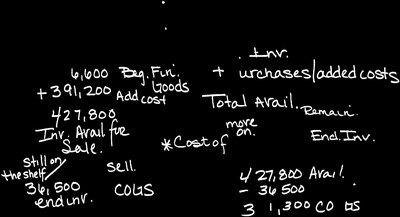
Try solving on your own before revealing the answer!
Final Answer:
COGS =
This formula helps you determine the cost of goods sold by accounting for inventory changes and manufacturing costs.
Q3. Indicate the flow of the cost of direct material through the accounting system.
Background
Topic: Flow of Costs in Manufacturing
This question tests your understanding of how direct material costs move through inventory accounts in a manufacturing company.
Key Terms:
Raw Materials Inventory: Where direct materials are stored before use.
Work-in-Process Inventory: Where costs accumulate as products are being manufactured.
Finished Goods Inventory: Where completed products are stored before sale.
Cost of Goods Sold: The cost of products that have been sold.
Step-by-Step Guidance
Start with the purchase of direct materials, which are recorded in Raw Materials Inventory.
When materials are used in production, their cost is transferred to Work-in-Process Inventory.
After production is complete, the cost moves to Finished Goods Inventory.
When goods are sold, the cost is transferred to Cost of Goods Sold.
Try solving on your own before revealing the answer!
Final Answer:
Flow: Raw Materials Inventory → Work-in-Process Inventory → Finished Goods Inventory → Cost of Goods Sold.
This sequence shows how direct material costs are tracked through the manufacturing process.
Q4. Indicate whether each cost is a Product Cost or a Period Cost, and classify Product Costs as Direct Material, Direct Labor, or Manufacturing Overhead.
Background
Topic: Product vs. Period Costs
This question tests your ability to distinguish between costs that are capitalized as inventory (product costs) and those expensed immediately (period costs).
Key Terms:
Product Cost: Costs directly related to manufacturing (Direct Material, Direct Labor, Manufacturing Overhead).
Period Cost: Costs not directly tied to production, expensed in the period incurred.
Step-by-Step Guidance
Identify whether the cost is related to production or administration/selling.
If related to production, classify as Direct Material, Direct Labor, or Manufacturing Overhead.
If related to administration or selling, classify as Period Cost.
Try solving on your own before revealing the answer!
Final Answer:
The salary of the accounting manager: Period Cost. The wages of assembly workers: Product Cost - Direct Labor. The production supervisor's salary: Product Cost - Manufacturing Overhead.
Product costs are included in inventory, while period costs are expensed immediately.
Q5. Calculate the total overhead applied to a job using machine hours.
Background
Topic: Overhead Allocation
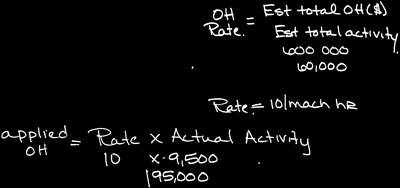
This question tests your ability to calculate applied overhead using a predetermined rate based on machine hours.
Key Formula:
Step-by-Step Guidance
Calculate the predetermined overhead rate using estimated overhead and machine hours.
Multiply the rate by the actual machine hours used for the job.
Try solving on your own before revealing the answer!
Final Answer:
Predetermined overhead rate = per machine hour. Applied overhead = .
Overhead is allocated based on actual machine hours used.
Q6. Calculate manufacturing overhead allocated to products using machine hours.
Background
Topic: Overhead Allocation Using Machine Hours
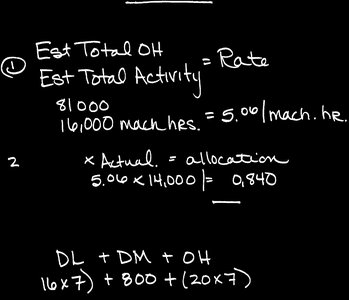
This question tests your ability to allocate manufacturing overhead based on machine hours.
Key Formula:
Step-by-Step Guidance
Calculate the predetermined overhead rate using estimated values.
Multiply the rate by the actual machine hours used during the year.
Try solving on your own before revealing the answer!
Final Answer:
Predetermined overhead rate = per machine hour. Allocated overhead = .
Overhead is allocated based on the actual machine hours used.
Q7. Calculate the total cost of a catering job given direct materials, direct labor, and overhead rates.
Background
Topic: Job Costing
This question tests your ability to calculate total job cost by summing direct materials, direct labor, and allocated overhead.
Key Formula:
Step-by-Step Guidance
Multiply the direct labor rate by the number of labor hours.
Multiply the overhead rate by the number of labor hours.
Add the direct materials cost to the sums from steps 1 and 2.
Try solving on your own before revealing the answer!
Final Answer:
Total cost = .
All cost components are summed to find the total job cost.
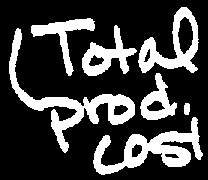
Q8. Calculate the total product cost for the year given various factory and corporate costs.
Background
Topic: Product Cost Calculation
This question tests your ability to distinguish between product and period costs and sum product costs for the year.
Key Terms:
Product Costs: Factory worker wages, factory rent, factory materials.
Period Costs: Chief Financial Officer's salary, corporate headquarters' rent.
Step-by-Step Guidance
Identify which costs are product costs (related to manufacturing).
Sum all product costs to get the total product cost for the year.
Try solving on your own before revealing the answer!
Final Answer:
Total product cost = .
Only costs directly related to manufacturing are included in product cost.
Q12. Calculate the cost of goods manufactured for the month for Soles for Souls, Inc.
Background
Topic: Cost of Goods Manufactured Calculation
This question tests your ability to calculate the total manufacturing cost for a given period.
Key Formula:
Step-by-Step Guidance
Multiply the direct materials cost per shoe by the number of shoes manufactured.
Multiply the direct labor cost per shoe by the number of shoes manufactured.
Add the allocated manufacturing overhead to the sum of direct materials and direct labor.

Try solving on your own before revealing the answer!
Final Answer:
Cost of goods manufactured = (3 + 2) \times 5,000 + 2,000 = 5 \times 5,000 + 2,000 = 25,000 + 2,000 = .
Direct materials and labor are multiplied by units produced, then overhead is added.
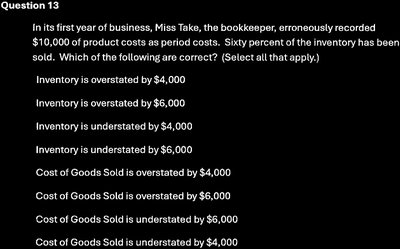
Q13. Miss Take erroneously recorded $10,000 of product costs as period costs. Sixty percent of the inventory has been sold. Which of the following are correct?
Background
Topic: Inventory and Cost of Goods Sold Misallocation
This question tests your understanding of how misallocating product costs affects inventory and COGS.
Key Terms:
Product Costs: Should be included in inventory until sold.
Period Costs: Expensed immediately, not included in inventory.
Step-by-Step Guidance
Calculate the portion of the $10,000 that should have been allocated to inventory (40%) and to COGS (60%).
Determine how misallocation affects reported inventory and COGS.
Try solving on your own before revealing the answer!
Final Answer:
Inventory is understated by $4,000 (40% of $10,000). COGS is understated by $6,000 (60% of $10,000).
Misallocating product costs as period costs reduces both inventory and COGS by the respective proportions.
