 Back
BackStep-by-Step Guidance for Financial Ratios in Construction Accounting
Study Guide - Smart Notes
 Tailored notes based on your materials, expanded with key definitions, examples, and context.
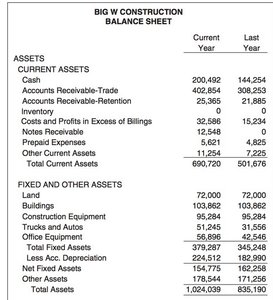
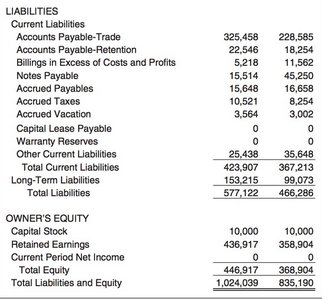
Q1. How do you determine the quick ratio for the commercial construction company in Figures 2-2 and 2-3? What insight does this give you into the company’s financial operations?
Background
Topic: Quick Ratio (Acid-Test Ratio)
This question tests your understanding of liquidity ratios, specifically the quick ratio, which measures a company's ability to pay its current liabilities using its most liquid assets (cash and accounts receivable, excluding retention).
Key Terms and Formula:
Quick Ratio: Measures short-term liquidity without relying on inventory or less liquid assets.
Formula:
Step-by-Step Guidance
Identify the values for cash and accounts receivable (trade only) from the balance sheet. Do not include accounts receivable-retention.
Find the total current liabilities from the balance sheet.
Add together the cash and accounts receivable (trade) amounts to get the numerator.
Set up the quick ratio formula using these values.
Try solving on your own before revealing the answer!
Final Answer: 1.42
This means the company has $1.42 in liquid assets for every $1 of current liabilities, which is slightly higher than the expected value but not excessive.
Q2. How do you determine the current ratio for the commercial construction company in Figures 2-2 and 2-3? What insight does this give you into the company’s financial operations?
Background
Topic: Current Ratio
This question tests your ability to assess a company's overall liquidity by comparing all current assets to current liabilities.
Key Terms and Formula:
Current Ratio: Measures the ability to cover short-term obligations with all current assets.
Formula:
Step-by-Step Guidance
Find the total current assets and total current liabilities from the balance sheet.
Set up the current ratio formula using these values.
Interpret what a ratio between 1.0 and 2.5 means for the company’s liquidity and asset allocation.
Try solving on your own before revealing the answer!
Final Answer: 1.63
This indicates the company is likely to meet its short-term obligations without having too much tied up in current assets.
Q3. How do you determine the current liabilities to net worth ratio for the commercial construction company in Figures 2-2 and 2-3? What insight does this give you into the company’s financial operations?
Background
Topic: Current Liabilities to Net Worth Ratio
This ratio measures the risk short-term creditors are taking compared to the owners’ equity in the company.
Key Terms and Formula:
Current Liabilities to Net Worth Ratio: Indicates the proportion of owner’s equity that is covered by current liabilities.
Formula:
Step-by-Step Guidance
Find the total current liabilities and net worth (owner’s equity) from the balance sheet.
Set up the ratio formula using these values.
Interpret what a ratio below or above 1.0 means for creditor risk.
Try solving on your own before revealing the answer!
Final Answer: 0.95 or 95%
This means short-term creditors have less at risk than the owners, which is favorable for creditors.
Q4. How do you determine the debt to equity ratio for the commercial construction company in Figures 2-2 and 2-3? What insight does this give you into the company’s financial operations?
Background
Topic: Debt to Equity Ratio
This ratio measures the risk all creditors are taking compared to the owners’ investment in the company.
Key Terms and Formula:
Debt to Equity Ratio: Indicates the proportion of total liabilities to owner’s equity.
Formula:
Step-by-Step Guidance
Find the total liabilities and net worth from the balance sheet.
Set up the debt to equity ratio formula using these values.
Interpret what a ratio below or above 2.0 means for the company’s financial leverage and risk.
Try solving on your own before revealing the answer!
Final Answer: 1.29
This suggests the company is not over-leveraged and can likely service its debt.
Q5. How do you determine the fixed assets to net worth ratio for the commercial construction company in Figures 2-2 and 2-3? What insight does this give you into the company’s financial operations?
Background
Topic: Fixed Assets to Net Worth Ratio
This ratio measures how much of the owner’s equity is tied up in fixed assets, indicating capital intensity and risk during downturns.
Key Terms and Formula:
Fixed Assets to Net Worth Ratio: Shows the proportion of equity invested in fixed assets.
Formula:
Step-by-Step Guidance
Find the net fixed assets and net worth from the balance sheet.
Set up the fixed assets to net worth ratio formula using these values.
Interpret what a higher or lower ratio means for the company’s risk profile.
Try solving on your own before revealing the answer!
Final Answer: 0.35 or 35%
This is higher than the median, indicating a heavier investment in fixed assets.
Q6. How do you determine the current assets to total assets ratio for the commercial construction company in Figures 2-2 and 2-3? What insight does this give you into the company’s financial operations?
Background
Topic: Current Assets to Total Assets Ratio
This ratio measures the liquidity of the company’s assets, showing what portion of total assets are current (liquid).
Key Terms and Formula:
Current Assets to Total Assets Ratio: Indicates the proportion of assets that are liquid.
Formula:
Step-by-Step Guidance
Find the total current assets and total assets from the balance sheet.
Set up the current assets to total assets ratio formula using these values.
Interpret what a higher or lower ratio means for the company’s asset structure and liquidity.
Try solving on your own before revealing the answer!
Final Answer: 0.67
This is slightly below the typical range, indicating a heavier investment in fixed assets.
Q7. How do you determine the collection period and receivable turns for the commercial construction company in Figures 2-2 and 2-3, with and without retention? What insight does this give you into the company’s financial operations?
Background
Topic: Collection Period and Receivable Turns
This question tests your ability to analyze how quickly a company collects its receivables and how efficiently it turns over its accounts receivable.
Key Terms and Formulas:
Collection Period: Average number of days to collect receivables.
Receivable Turns: Number of times receivables are collected in a year.
Formulas:
Step-by-Step Guidance
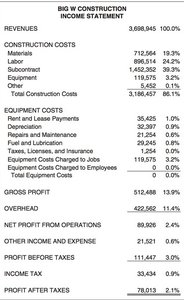
Calculate the average accounts receivable for the year (with and without retention) using beginning and ending balances from the balance sheet.
Find the total revenues from the income statement.
Set up the collection period formula using these values.
Set up the receivable turns formula using the calculated collection period.
Try solving on your own before revealing the answer!
Final Answer: Collection Period (excluding retention): 35.1 days; Receivable Turns: 10.4
days
These values indicate the company collects its receivables efficiently, below the recommended 45 days.
