Ch.4 - Reactions in Aqueous Solution
McMurry - Chemistry 8th Edition
McMurry8th EditionChemistryISBN: 9781292336145Not the one you use?Change textbook
Chapter 4, Problem 13

Identify the element that gets oxidized and the oxidizing agent in the reaction. (LO 4.19) (a) (b) (c) (d)

Verified step by step guidance
1
insert step 1> Identify the chemical reaction involved in the problem. If the reaction is not provided, consider a hypothetical reaction for explanation purposes.
insert step 2> Assign oxidation numbers to each element in the reactants and products. This will help determine which elements undergo changes in oxidation state.
insert step 3> Identify the element that gets oxidized by finding the element whose oxidation number increases. This element loses electrons.
insert step 4> Identify the oxidizing agent, which is the substance that gets reduced (gains electrons) and causes the oxidation of another substance.
insert step 5> Verify your findings by ensuring that the total increase in oxidation numbers equals the total decrease, maintaining the balance of electrons in the reaction.

Key Concepts

Here are the essential concepts you must grasp in order to answer the question correctly.

Oxidation and Reduction

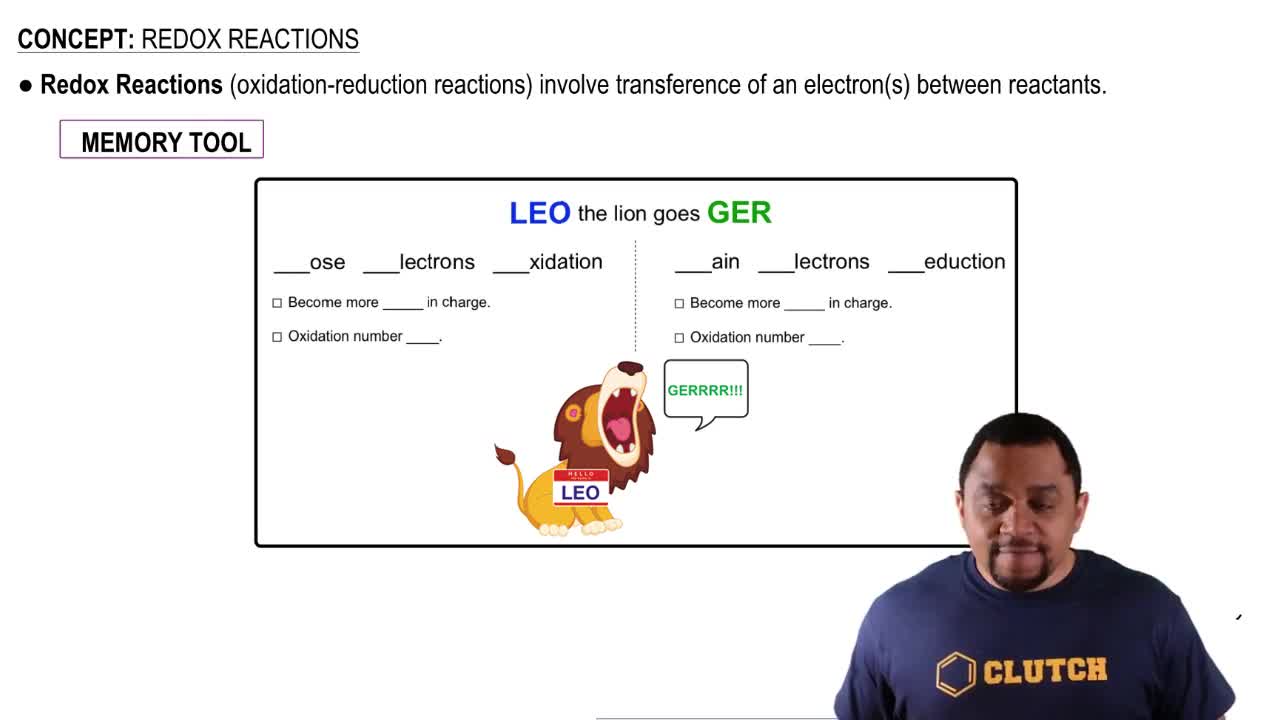
Oxidation and reduction are chemical processes that involve the transfer of electrons between substances. Oxidation refers to the loss of electrons, while reduction refers to the gain of electrons. In a redox reaction, one species is oxidized and another is reduced, which is essential for understanding how these reactions occur.
Recommended video:
Guided course
01:53
Oxidation and Reduction Reactions

Oxidizing Agent

An oxidizing agent is a substance that facilitates oxidation by accepting electrons from another species. It is itself reduced in the process. Identifying the oxidizing agent is crucial in redox reactions, as it helps to determine which element is undergoing oxidation and the overall electron flow in the reaction.
Recommended video:
Guided course
01:01
Oxidizing and Reducing Agents

Identifying Oxidation States

Oxidation states (or numbers) are assigned to elements in a compound to indicate their degree of oxidation or reduction. By analyzing the changes in oxidation states of the elements involved in a reaction, one can determine which element is oxidized (increased oxidation state) and which is reduced (decreased oxidation state). This is a fundamental step in identifying the oxidizing agent.
Recommended video:
Guided course
02:42
Oxidation Numbers
Related Practice
Textbook Question
When 75.0 mL of a 0.100 M lead(II) nitrate solution is mixed with 100.0 mL of a 0.190 M potassium iodide solu-tion, a yellow-orange precipitate of lead(II) iodide is formed. What is the mass in grams of lead(II) iodide formed? Assume the reaction goes to completion. (LO 4.11, 4.15)(a) 1.729 g(b) 3.458 g(c) 4.380 g (d) 8.760 g
1393
views
1
comments
Textbook Question
Assign oxidation numbers to each atom in Borax, Na2B4O7, a mineral used in laundry detergent. (LO 4.18)
495
views

Textbook Question
The most strongly reducing elements are listed at the top of the partial activity series table provided. Use the activity series to predict which reaction will occur. (LO 4.20) (a) (b) (c) (d)

275
views
Textbook Question

Box (a) represents 1.0 mL of a solution of particles at a given concentration. Which of the boxes (b)–(d) represents 1.0 mL of the solution that results after (a) has been diluted by doubling the volume of its solvent? (a)

(b)

(c)

(d)

399
views
Textbook Question
Assume that an aqueous solution of a cation, represented as a red sphere, is allowed to mix with a solution of an anion, represented as a yellow sphere. Three possible outcomes are represented by boxes (1)–(3):

Which outcome corresponds to each of the following reactions?(a) 2 Na+(aq) + CO32-(aq) S(b) Ba2+(aq) + CrO42-(aq) S(c) 2 Ag+(aq) + SO32-(aq) S
590
views
Textbook Question
Succinic acid, an intermediate in the metabolism of food molecules, has a molecular weight of 118.1. When 1.926 g of succinic acid was dissolved in water and titrated, 65.20 mL of 0.5000 M NaOH solution was required to neutralize the acid. How many acidic hydrogens are there in a mol-ecule of succinic acid? (LO 4.16)(a) 1(b) 2 (c) 3 (d) 4
1095
views