Back

Binary Acids quiz

Control buttons has been changed to "navigation" mode.
1/15
  • What defines a binary acid?

    A binary acid is a covalent compound containing hydrogen ions (H+) bonded to a nonmetal anion, and it does not contain oxygen.
  • Give two examples of binary acids.

    Hydrobromic acid (HBr) and hydrosulfuric acid (H2S) are examples of binary acids.
  • Which group of elements do strong binary acids typically involve?

    Strong binary acids typically involve hydrogen bonded to halogens, which are group 7A elements.
  • Name the three strong binary acids.

    The three strong binary acids are hydroiodic acid (HI), hydrobromic acid (HBr), and hydrochloric acid (HCl).
  • Why is hydrofluoric acid (HF) not considered a strong binary acid?

    Hydrofluoric acid (HF) is not a strong binary acid because it only partially dissociates in water, making it a weak acid.
  • What is the relationship between strong acids and electrolytes?

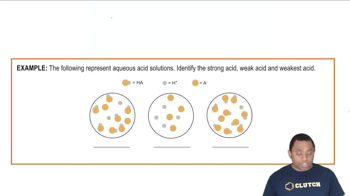
    Strong acids are strong electrolytes because they dissociate completely in water, producing many ions.
  • How do weak acids behave in water compared to strong acids?

    Weak acids only partially dissociate in water, producing fewer ions and favoring the molecular (reactant) form.
  • What does it mean for an acid to 'donate a proton'?

    To 'donate a proton' means the acid releases an H+ ion to the surrounding water.
  • How is the dissociation of a strong acid represented in a chemical equation?

    The dissociation of a strong acid is shown with a single solid arrow pointing toward the products, indicating complete ionization.
  • How is the dissociation of a weak acid represented in a chemical equation?

    The dissociation of a weak acid is shown with two arrows, a larger one pointing back to reactants, indicating partial ionization and favoring the reactant side.
  • What periodic trend is used to compare the strength of binary acids in the same period?

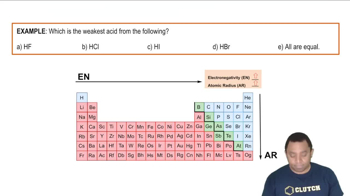
    Electronegativity is used to compare the strength of binary acids in the same period; higher electronegativity means a stronger acid.
  • What periodic trend is used to compare the strength of binary acids in the same group?

    Atomic radius is used to compare the strength of binary acids in the same group; a larger atomic radius means a stronger acid.
  • Why does a larger atomic radius increase binary acid strength within a group?

    A larger atomic radius weakens the bond to hydrogen, making it easier for the acid to donate a proton and thus increasing acidity.
  • What is the main difference in ion production between strong and weak binary acids?

    Strong binary acids produce many ions due to complete dissociation, while weak binary acids produce few ions due to partial dissociation.
  • What is the significance of the direction of arrows in acid dissociation equations?

    A single arrow indicates complete dissociation (strong acid), while two arrows with a larger reverse arrow indicate partial dissociation and reactant favoring (weak acid).