Skip to main content
General Chemistry
My Course
Learn
Exam Prep
AI Tutor
Study Guides
Textbook Solutions
Flashcards
Explore
Try the app
My Course
Learn
Exam Prep
AI Tutor
Study Guides
Textbook Solutions
Flashcards
Explore
Try the app
Back
Equilibrium Constant K quiz
You can tap to flip the card.
What does the equilibrium constant (K) indicate about a chemical reaction?
You can tap to flip the card.
👆
What does the equilibrium constant (K) indicate about a chemical reaction?
K indicates whether the forward or reverse reaction is favored at equilibrium.
Track progress
Control buttons has been changed to "navigation" mode.
1/15
Related flashcards
Related practice
Recommended videos
Equilibrium Constant K definitions
Equilibrium Constant K
15 Terms
Equilibrium Constant K quiz #1
Equilibrium Constant K
10 Terms
Equilibrium Constant (K)
16. Chemical Equilibrium
6 problems
Topic
Jules
Equilibrium Constant Calculations
16. Chemical Equilibrium
7 problems
Topic
Jules
16. Chemical Equilibrium - Part 1 of 2
5 topics
13 problems
Chapter
Jules
16. Chemical Equilibrium - Part 2 of 2
5 topics
13 problems
Chapter
Jules
Guided course
01:14
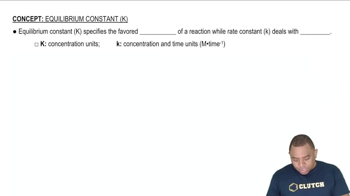
Equilibrium Constant K
6616
views
114
rank
Guided course
03:20
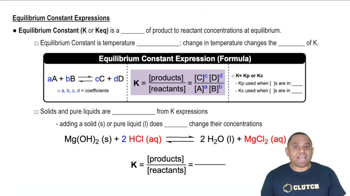
Equilibrium Constant Expressions
5789
views
123
rank
Guided course
01:07
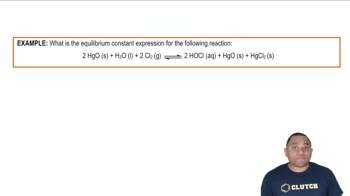
Equilibrium Constant Expressions Example
5006
views
112
rank
1
comments
Terms in this set (15)
Hide definitions
What does the equilibrium constant (K) indicate about a chemical reaction?
K indicates whether the forward or reverse reaction is favored at equilibrium.
How is the equilibrium constant (K) calculated from a balanced chemical equation?
K is the ratio of the concentrations of products to reactants, each raised to the power of their coefficients.
What does a K value greater than 1 signify about a reaction at equilibrium?
A K greater than 1 means the forward reaction is favored, producing more products.
What does a K value less than 1 indicate about the favored direction of a reaction?
A K less than 1 means the reverse reaction is favored, resulting in more reactants.
What does it mean if the equilibrium constant K equals 1?
If K equals 1, neither the forward nor reverse reaction is favored, and product and reactant concentrations are equal.
Which physical states are excluded from the equilibrium constant expression and why?
Solids and pure liquids are excluded because their concentrations do not change with pressure.
How does temperature affect the equilibrium constant K?
K is temperature-dependent, so changing the temperature changes the value of K.
What is the relationship between the equilibrium constant (K) and the rate constants (k) of a reaction?
K equals the rate constant of the forward reaction divided by the rate constant of the reverse reaction.
What is the main difference between the equilibrium constant (K) and the rate constant (k)?
K indicates reaction direction at equilibrium, while k measures the speed of the reaction.
In the equilibrium expression, how are coefficients from the balanced equation used?
Coefficients become exponents for the concentrations in the equilibrium expression.
What are Kc and Kp, and when is each used?
Kc is used for concentrations in molarity, and Kp is used for concentrations in atmospheres.
Why are solids and pure liquids not included in equilibrium expressions?
Their concentrations remain constant and are unaffected by changes in pressure.
If a reaction at equilibrium has more products than reactants, what can you say about K?
K will be greater than 1, indicating the forward reaction is favored.
If a reaction at equilibrium has more reactants than products, what does this say about K?
K will be less than 1, meaning the reverse reaction is favored.
What units are associated with the rate constant (k) that are not part of the equilibrium constant (K)?
The rate constant (k) includes time units, such as seconds inverse, while K does not.
 BackBack
 01:14
01:14