Skip to main content
General Chemistry
My Course
Learn
Exam Prep
AI Tutor
Study Guides
Textbook Solutions
Flashcards
Explore
Try the app
My Course
Learn
Exam Prep
AI Tutor
Study Guides
Textbook Solutions
Flashcards
Explore
Try the app
Back
Extraction quiz
You can tap to flip the card.
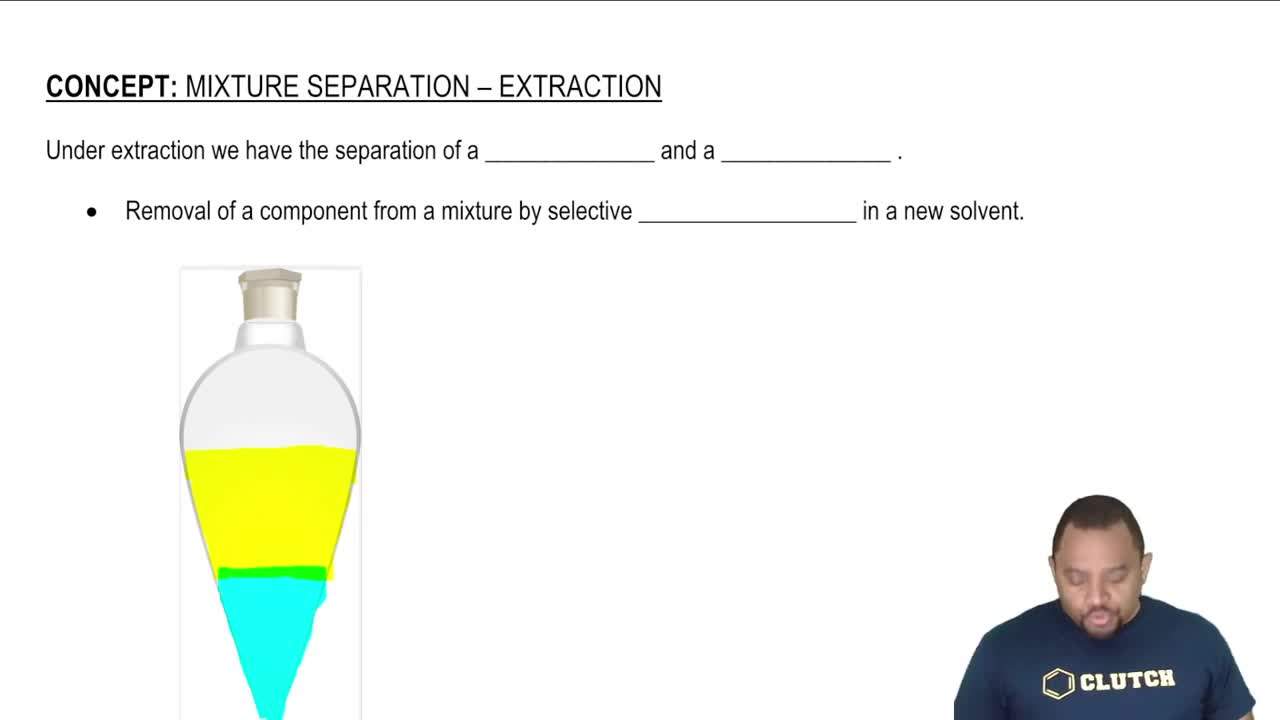
What is the main principle behind the extraction technique in chemistry?
You can tap to flip the card.
👆
What is the main principle behind the extraction technique in chemistry?
Extraction separates components from a mixture based on their differing solubilities in various solvents.
Track progress
Control buttons has been changed to "navigation" mode.
1/15
Related flashcards
Related practice
Recommended videos
Extraction definitions
Extraction
15 Terms
Extraction quiz #1
Extraction
10 Terms
Extraction
4. BONUS: Lab Techniques and Procedures
10 problems
Topic
Test for Ions and Gases
4. BONUS: Lab Techniques and Procedures
10 problems
Topic
4. BONUS: Lab Techniques and Procedures
7 topics
15 problems
Chapter
Guided course
08:52
Acid-Base Extraction
5353
views
3
rank
Guided course
05:31
Extraction
4750
views
3
rank
Terms in this set (15)
Hide definitions
What is the main principle behind the extraction technique in chemistry?
Extraction separates components from a mixture based on their differing solubilities in various solvents.
Why is acid-base extraction commonly used in the laboratory?
Acid-base extraction is used because altering the pH can change the solubility of compounds, allowing for selective separation.
What happens to acetic acid when a strong base is added during extraction?
Acetic acid is deprotonated to form the acetate ion, which is polar and moves into the aqueous layer.
How can you recover acetic acid as a solid after it has been extracted into the aqueous layer?
By adding acid to the aqueous layer, the acetate ion is reprotonated to acetic acid, which precipitates as a solid.
Why do ions formed during extraction move into the aqueous layer?
Ions are polar and thus are more soluble in the polar aqueous layer than in the nonpolar organic layer.
What is the purpose of using pH strips during an extraction?
pH strips are used to ensure that the organic layer is completely basic, confirming all acid has been neutralized.
Why must pressure be released during mixing in a separatory funnel?
Mixing acids and bases can generate gas and pressure, so the funnel must be vented to prevent accidents.
Why is it better to add a weak base before a strong base in acid-base extraction?
A weak base reacts only with the most acidic component, allowing for selective separation of acids.
What does a lower pKa value indicate about a compound's acidity?
A lower pKa means the compound is a stronger acid.
How does the addition of sodium bicarbonate help in separating acetic acid from a mixture?
Sodium bicarbonate, a weak base, reacts with acetic acid to form the acetate ion, which moves into the aqueous layer.
What is the next step after extracting the most acidic compound with a weak base?
A stronger base is added to react with the next most acidic compound, repeating the extraction process.
Why do compounds made only of carbon and hydrogen remain in the organic layer during extraction?
Such compounds are nonpolar and do not react with acids or bases, so they stay in the nonpolar organic layer.
How is a neutral amine like methylamine extracted from the organic layer?
An acid such as HCl is added, converting methylamine into a charged methylammonium ion, which moves into the aqueous layer.
What is the role of acidified water after extracting a charged ion into the aqueous layer?
Acidified water donates a proton to the ion, neutralizing it and causing it to precipitate as a solid.
What fundamental chemical concepts are essential for understanding extraction techniques?
Understanding acid-base chemistry, including pKa values and solubility principles, is essential for successful extraction.
 BackBack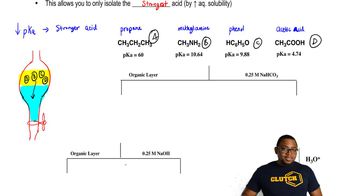
 08:52
08:52