General Chemistry
My Course
Learn
Exam Prep
AI Tutor
Study Guides
Textbook Solutions
Flashcards
Explore
My Course
Learn
Exam Prep
AI Tutor
Study Guides
Textbook Solutions
Flashcards
Explore
Back
Hydrogen Compounds quiz
You can tap to flip the card.
Define:
What are hydrides in chemistry?
You can tap to
flip the card.
👆
What are hydrides in chemistry?
Hydrides are binary compounds containing hydrogen and a metal or nonmetal.
Track progress
Control buttons has been changed to "navigation" mode.
1/15
Related flashcards
Related practice
Recommended videos
Hydrogen Compounds definitions
Hydrogen Compounds
15 Terms
Hydrogen Compounds
23. Chemistry of the Nonmetals
3 problems
Topic

Jules
Production of Hydrogen
23. Chemistry of the Nonmetals
3 problems
Topic
Jules
23. Chemistry of the Nonmetals - Part 1 of 2
5 topics
12 problems
Chapter
Jules
23. Chemistry of the Nonmetals - Part 2 of 2
6 topics
11 problems
Chapter
Jules
Guided course
02:00
Ionic Hydrides
Jules Bruno
596
views
Guided course
00:43
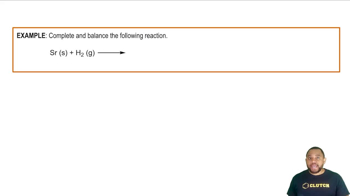
Hydrogen Compounds Example
Jules Bruno
642
views
Guided course
02:04
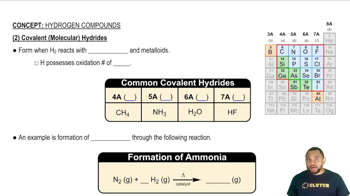
Covalent (Molecular) Hydrides
Jules Bruno
643
views
Terms in this set (15)
Hide definitions
What are hydrides in chemistry?
Hydrides are binary compounds containing hydrogen and a metal or nonmetal.
What are the three types of hydrides formed by hydrogen?
The three types are ionic, covalent (molecular), and metallic hydrides.
Which groups of metals form ionic hydrides with hydrogen?
Group 1A and 2A metals form ionic hydrides with hydrogen, except for beryllium.
What is the oxidation number of hydrogen in ionic hydrides?
In ionic hydrides, hydrogen has an oxidation number of -1.
What is the general formula for an ionic hydride formed with a group 1A metal?
The general formula is MH, where M is the group 1A metal.
How does the formula for an ionic hydride differ for group 2A metals?
For group 2A metals, the formula is MH₂ because the metal has a +2 charge and hydrogen is -1.
What type of elements form covalent hydrides with hydrogen?
Covalent hydrides are formed when hydrogen reacts with nonmetals and metalloids.
What is the oxidation number of hydrogen in covalent hydrides?
In covalent hydrides, hydrogen has an oxidation number of +1.
Name two common examples of covalent hydrides.
Water (H₂O) and methane (CH₄) are common covalent hydrides.
What is the typical reaction for forming ammonia as a covalent hydride?
Diatomic nitrogen reacts with diatomic hydrogen to produce ammonia (NH₃), usually with heat and a catalyst.
Which elements are not involved in forming covalent hydrides among nonmetals and metalloids?
Boron and astatine are not involved in forming covalent hydrides.
What type of hydride is formed when hydrogen reacts with transition metals?
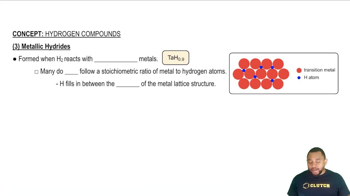
Metallic hydrides are formed when hydrogen reacts with transition metals.
How do hydrogen atoms fit into the structure of metallic hydrides?
Hydrogen atoms fill the gaps in the metal lattice structure of transition metals.
Why might the formula for a metallic hydride not have whole numbers?
Because hydrogen atoms occupy spaces in the metal lattice irregularly, leading to non-stoichiometric ratios.
What is an example of a metallic hydride with a non-whole number formula?
Tantalum hydride can have a formula like TaH₀.₉, showing a non-whole number ratio.