How can you determine which acid is the weakest using pKa values?
The weakest acid is the one with the highest pKa value, because a higher pKa indicates a lower Ka and thus less tendency to donate protons.
Given that the pKa of hypochlorous acid is 7.53, what does this indicate about its acid strength?
A pKa of 7.53 indicates that hypochlorous acid is a weak acid, since weak acids have pKa values greater than 0 and Ka values less than 1.
How can you determine which base is the strongest using Kb values?
The strongest base is the one with the highest Kb value, because a higher Kb indicates a greater tendency to accept protons and ionize in solution.
What is excluded from the equilibrium constant expressions for Ka and Kb?
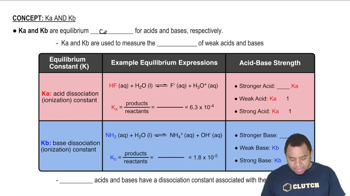
Solids and liquids, such as water, are excluded from the equilibrium constant expressions for Ka and Kb. Only the concentrations of aqueous species are included.
How does the Ka value of hydrofluoric acid compare to 1, and what does this indicate?
The Ka value of hydrofluoric acid is 6.3 × 10⁻⁴, which is less than 1. This indicates that hydrofluoric acid is a weak acid.
What happens to ammonia when it reacts with water in terms of ion formation?
Ammonia accepts a proton from water, forming the ammonium ion and leaving behind the hydroxide ion. This reaction demonstrates ammonia's role as a weak base.
Why are Ka and Kb values typically not discussed for strong acids and bases?
Ka and Kb values for strong acids and bases are much greater than 1, making their ionization nearly complete. As a result, their equilibrium constants are not as useful for comparison.
What is the mathematical relationship between Kw, Ka, and Kb for a conjugate acid-base pair?
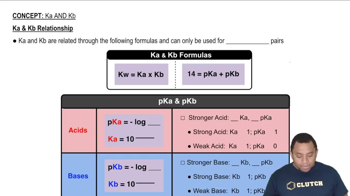
The relationship is Kw = Ka × Kb, where Kw is the ionization constant of water. This equation connects the acid and base dissociation constants of conjugate pairs.
How can you calculate Ka if you know the pKa of an acid?
Ka can be calculated using the formula Ka = 10⁻ᵖᴷᵃ. This allows conversion from the logarithmic pKa value to the equilibrium constant Ka.
What does a pKb value represent and how is it related to Kb?
A pKb value is the negative logarithm of the base dissociation constant, Kb. If you know pKb, you can find Kb using Kb = 10⁻ᵖᴷᵇ.