Stoichiometry definitions Flashcards

Stoichiometry definitions
Control buttons has been changed to "navigation" mode.
1/15
  • Stoichiometry
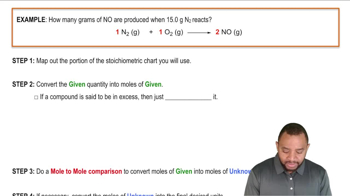
    Study of quantitative relationships in a balanced chemical equation to predict product amounts from reactants.
  • Balanced Chemical Equation
    An equation with equal numbers of each type of atom on both sides, crucial for stoichiometric calculations.
  • Mole
    A unit representing 6.022 x 10^23 particles, used to convert between mass and number of particles in stoichiometry.
  • Stoichiometric Chart
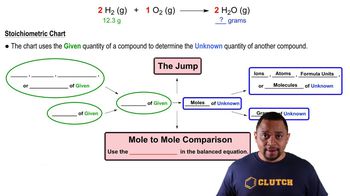
    A tool used to convert given quantities to unknown quantities through mole-to-mole comparisons.
  • Given Information
    The initial quantity of a substance provided in a stoichiometric problem, often in grams or moles.
  • Unknown Information
    The quantity of a substance to be determined in a stoichiometric problem, derived from given information.
  • Mole-to-Mole Comparison
    A step in stoichiometry using coefficients from a balanced equation to relate moles of reactants to products.
  • Coefficients
    Numbers in a chemical equation indicating the ratio of moles of each substance involved in the reaction.
  • Grams
    A unit of mass used in stoichiometry to measure the given or unknown quantities of substances.
  • Atoms
    The smallest unit of an element, used in stoichiometry to express quantities of substances.
  • Molecules
    Groups of atoms bonded together, used in stoichiometry to express quantities of substances.
  • Ions
    Charged particles formed when atoms gain or lose electrons, used in stoichiometry to express quantities.
  • Formula Units
    The lowest whole number ratio of ions in an ionic compound, used in stoichiometry to express quantities.
  • Jump
    The transition from moles of given to moles of unknown in stoichiometry, using a balanced equation.
  • Conversion
    The process of changing a quantity from one unit to another, such as grams to moles, in stoichiometry.