Back
BackGeneral Chemistry Study Guidance: Equilibrium, Acids & Bases, and Solution Calculations
Study Guide - Smart Notes
 Tailored notes based on your materials, expanded with key definitions, examples, and context.
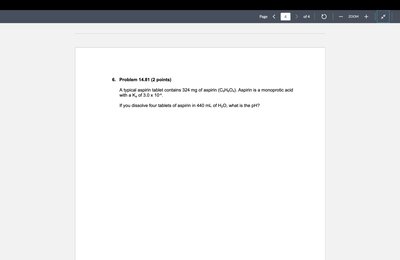
Q1. A typical aspirin tablet contains 325 mg of aspirin (C9H8O4). Aspirin is a monoprotic acid with . If you dissolve four tablets of aspirin in 440 mL of H2O, what is the pH?
Background
Topic: Acid-Base Equilibria
This question tests your ability to calculate the pH of a solution containing a weak acid, using its mass, molar mass, and acid dissociation constant ().
Key Terms and Formulas
Monoprotic acid: An acid that donates one proton per molecule.
: Acid dissociation constant.
For a weak acid:
Step-by-Step Guidance
Calculate the total mass of aspirin dissolved: .
Convert the mass to moles using the molar mass of aspirin (): .
Calculate the initial concentration of aspirin in the solution: .
Set up the equilibrium expression for the dissociation of aspirin: .
Write the expression and set up the ICE table to solve for .
Try solving on your own before revealing the answer!
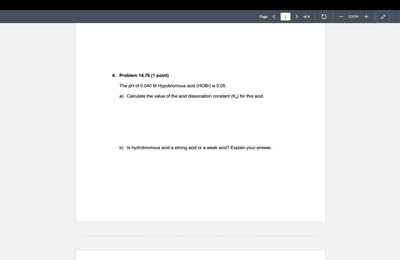
Q2. The pH of 0.040 M hydroferrous acid (HFO2H) is 5.05.
Background
Topic: Acid Dissociation and Strength
This question tests your ability to calculate the acid dissociation constant () from pH and concentration, and to determine whether the acid is strong or weak.
Key Terms and Formulas
Strong acid: Nearly complete dissociation; weak acid: partial dissociation.
Step-by-Step Guidance
Use the pH to find : .
Assume and .
Plug values into the expression: .
Compare the calculated to typical values for strong and weak acids to answer part (b).
Try solving on your own before revealing the answer!
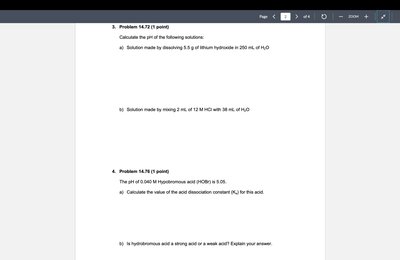
Q3. Calculate the pH of the following solutions:
Background
Topic: Solution Chemistry and pH Calculations
This question tests your ability to calculate pH for solutions made by dissolving bases or mixing acids and bases.
Key Terms and Formulas
For strong bases:
Step-by-Step Guidance
For part (a): Calculate moles of lithium hydroxide from mass and molar mass.
Find by dividing moles by volume (in liters).
Calculate and then using .
For part (b): Calculate moles of HCl and mix with moles of NaOH, then determine excess or .
Try solving on your own before revealing the answer!
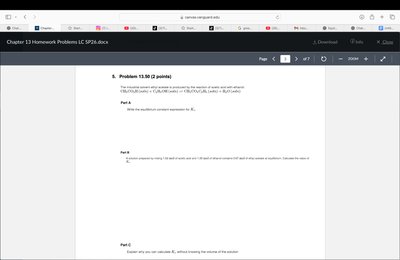
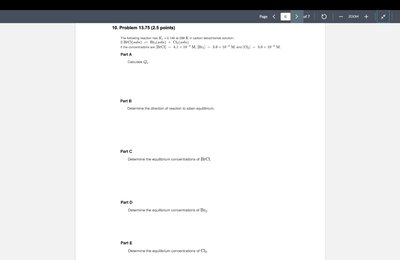
Q4. The following reaction occurs in a 1.0 L flask at constant temperature:
Background
Topic: Chemical Equilibrium
This question tests your ability to use equilibrium constants () and initial concentrations to determine equilibrium concentrations and the direction of reaction.
Key Terms and Formulas
Equilibrium constant ():
ICE table: Initial, Change, Equilibrium concentrations.
Step-by-Step Guidance
Write the balanced equation and set up the ICE table for all species.
Determine the initial concentrations given in the problem.
Set up the equilibrium expression using and solve for the change in concentration ().
Use the value of to determine the direction of the reaction (compare to $K_c$).
Try solving on your own before revealing the answer!
Q5. The double identity of nitrogen: a possibility for the reversal of ammonia and nitric acid synthesis
Background
Topic: Chemical Equilibrium and Reaction Direction
This question tests your understanding of equilibrium constants, reaction direction, and how changes in conditions affect equilibrium.
Key Terms and Formulas
Equilibrium constant ()
Reaction quotient ()
Le Chatelier's Principle
Step-by-Step Guidance
Write the equilibrium expression for the reaction.
Calculate using the provided concentrations.
Compare to to determine the direction of the reaction.
Predict how changes in concentration or pressure would affect the equilibrium position.
Try solving on your own before revealing the answer!