Rainwater is acidic because CO21g2 dissolves in the water, creating carbonic acid, H2CO3. If the rainwater is too acidic, it will react with limestone and seashells (which are principally made of calcium carbonate, CaCO3). Calculate the concentrations of carbonic acid, bicarbonate ion 1HCO3-2 and carbonate ion 1CO32 - 2 that are in a raindrop that has a pH of 5.60, assuming that the sum of all three species in the raindrop is 1.0 * 10-5 M.

(b) What is the most significant difference between the sulfides precipitated in group 2 and those precipitated in group 3?

Verified step by step guidance
Verified video answer for a similar problem:
Key Concepts
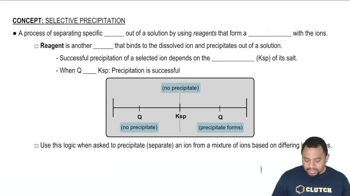
Selective Precipitation
Group 2 vs. Group 3 Sulfides
Precipitation Reagents
Suggest how the cations in each of the following solution mixtures can be separated: (c) Pb2 + and Al3 +.
In the course of various qualitative analysis procedures, the following mixtures are encountered: (c) Mg2+ and K+ (d) Ag+ and Mn2+. Suggest how each mixture might be separated.
Which of these equations relates the pOH of a buffer to the pš¾š of its weak base, analogous to the HendersonāHasselbalch equation for weak acids?
a. pš¾š=pOH+pš¾š=pOH+log[acid]/[base]
b. pš¾š=pOHālog[acid]/[base]
c. pš¾š=pOHālog[base]/[acid]
d. pš¾š=pOH+log[base]/[[acid]
In the course of various qualitative analysis procedures, the following mixtures are encountered: (a) Zn2+ and Cd2+. (b) Cr(OH)3 and Fe(OH)3 Suggest how each mixture might be separated.
