
Ch.7 - Covalent Bonding and Electron-Dot Structures
McMurry - Chemistry 8th Edition
McMurry8th EditionChemistryISBN: 9781292336145Not the one you use?Change textbook
Chapter 7, Problem 150

The reaction S81g2 S 4 S21g2 has ΔH° = + 237 kJ (b) The average S ¬ S bond dissociation energy is 225 kJ/mol. Using the value of ΔH° given above, what is the S ' S double bond energy in S21g2?

Verified step by step guidance
1
Identify the reaction: \( S_8(g) \rightarrow 4S_2(g) \) with \( \Delta H^\circ = +237 \text{ kJ} \).
Recognize that the reaction involves breaking \( S-S \) single bonds in \( S_8 \) and forming \( S=S \) double bonds in \( S_2 \).
Calculate the total energy required to break all the \( S-S \) single bonds in \( S_8 \). Since there are 8 \( S-S \) bonds, use the bond dissociation energy: \( 8 \times 225 \text{ kJ/mol} \).
Determine the energy change for forming \( S=S \) double bonds in \( S_2 \). Since 4 \( S_2 \) molecules are formed, calculate the energy for 4 \( S=S \) bonds.
Use the equation \( \Delta H^\circ = \text{Energy to break bonds} - \text{Energy to form bonds} \) to solve for the \( S=S \) double bond energy.

Verified video answer for a similar problem:

This video solution was recommended by our tutors as helpful for the problem above.
Video duration:
4m

Key Concepts

Here are the essential concepts you must grasp in order to answer the question correctly.

Bond Dissociation Energy

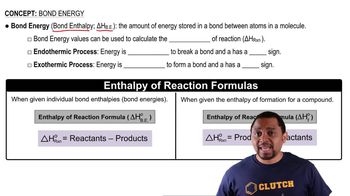
Bond dissociation energy (BDE) is the energy required to break a bond in a molecule, resulting in the formation of separate atoms or radicals. It is typically expressed in kJ/mol and reflects the strength of a chemical bond. In this question, the average S-S bond dissociation energy is given as 225 kJ/mol, which is crucial for calculating the energy associated with the S=S double bond.
Recommended video:

Enthalpy Change (ΔH°)

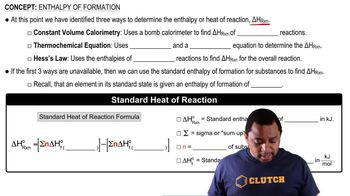
Enthalpy change (ΔH°) is a measure of the heat content change during a chemical reaction at constant pressure. A positive ΔH° indicates that the reaction is endothermic, meaning it absorbs heat from the surroundings. In this case, the given ΔH° of +237 kJ provides essential information for determining the energy associated with the formation or breaking of bonds in the reaction.
Recommended video:
Guided course
02:34
Enthalpy of Formation

Double Bond Energy

Double bond energy refers to the energy required to break a double bond between two atoms, which is typically greater than that of a single bond due to the additional shared pair of electrons. In this question, calculating the S=S double bond energy in S2(g) involves using the provided ΔH° and the average bond dissociation energy to find the specific energy associated with the double bond in sulfur.
Recommended video: