
Ch.9 - Thermochemistry: Chemical Energy
McMurry - Chemistry 8th Edition
McMurry8th EditionChemistryISBN: 9781292336145Not the one you use?Change textbook
Chapter 9, Problem 6a

Several processes are given in the table and labeled as endo- thermic or exothermic and given a sign for ∆H°. Which process is labeled with the correct sign of ∆H° and correct classification as endothermic or exothermic? (LO 9.8) Process (a) Ammonium nitrate dissolves in water, and the temperature of the solution decreases.

Verified step by step guidance
1
Identify the nature of the process: When ammonium nitrate dissolves in water and the temperature of the solution decreases, it indicates that the system is absorbing heat from the surroundings. This is a key characteristic of an endothermic reaction.
Understand the sign of ∆H°: For endothermic processes, the enthalpy change (∆H°) is positive. This is because the system gains heat, increasing its enthalpy.
Check the given classification and sign: The process should be labeled as endothermic with a positive ∆H°.
Compare with the problem statement: Ensure that the process of ammonium nitrate dissolving in water is correctly labeled as endothermic and that the sign of ∆H° is positive.
Conclude the correctness: If the process is labeled as endothermic and the sign of ∆H° is positive, then it is correctly classified and labeled.

Verified video answer for a similar problem:

This video solution was recommended by our tutors as helpful for the problem above.
Video duration:
4m

Key Concepts

Here are the essential concepts you must grasp in order to answer the question correctly.

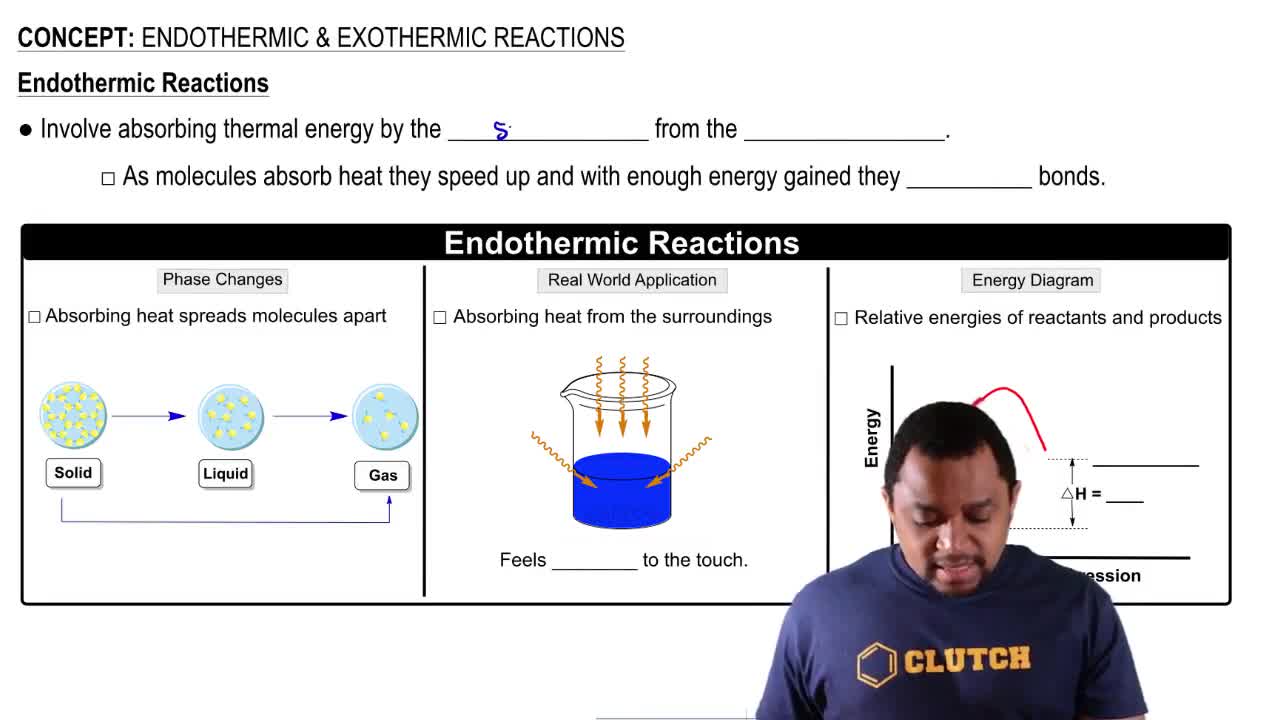
Endothermic and Exothermic Reactions

Endothermic reactions absorb heat from their surroundings, resulting in a decrease in temperature, while exothermic reactions release heat, causing an increase in temperature. The sign of the enthalpy change (∆H°) reflects this: positive for endothermic processes and negative for exothermic ones.
Recommended video:
Guided course
02:30
Endothermic & Exothermic Reactions

Enthalpy Change (∆H°)

Enthalpy change (∆H°) is a measure of the heat content of a system at constant pressure. It indicates whether a process is endothermic or exothermic. A positive ∆H° signifies that heat is absorbed (endothermic), while a negative ∆H° indicates that heat is released (exothermic).
Recommended video:
Guided course
02:34
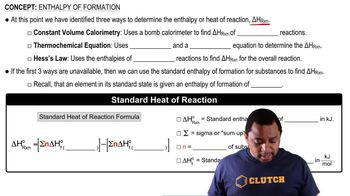
Enthalpy of Formation

Dissolution Process

The dissolution process involves a solute (like ammonium nitrate) dissolving in a solvent (like water). This process can be endothermic if it requires energy to break solute-solute and solvent-solvent interactions, leading to a decrease in the solution's temperature, which is observed when ammonium nitrate dissolves.
Recommended video:
Guided course
04:20
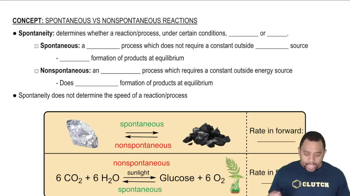
Spontaneity of Processes