Ch. 20 - Population Genetics and Evolution at the Population, Species, and Molecular Levels
Sanders - Genetic Analysis: An Integrated Approach 3rd Edition
Sanders3rd EditionGenetic Analysis: An Integrated ApproachISBN: 9780135564172Not the one you use?Change textbook
Chapter 20, Problem 43b

There are usually five or more colors of candy in each bag. Sort the candies by color, and if your bag has more than four colors, eat the least frequent color or colors. Once that is done, calculate the frequencies of the four remaining colors. Assume these frequencies represent four alleles of a gene, and use the description of the H-W equilibrium for more than two alleles for assistance.
Use this expansion to calculate the expected frequency of each possible genotype produced in a randomly mating population.

Verified step by step guidance
1
Sort the candies by color and count the frequency of each color. Identify the least frequent color(s) if there are more than four colors, and remove them from the analysis. This step ensures that only four colors (alleles) remain for further calculations.
Label the four remaining colors as alleles A, B, C, and D. Assign their respective frequencies as p, q, r, and s, where p + q + r + s = 1. These frequencies represent the allele frequencies in the population.
Recall the Hardy-Weinberg equilibrium principle for more than two alleles. The expected genotype frequencies in a randomly mating population are calculated using the formula: \( (p + q + r + s)^2 \). Expand this expression to include all possible genotype combinations.
Expand \( (p + q + r + s)^2 \) to calculate the expected frequencies of each genotype. The expansion includes terms for homozygous genotypes (e.g., \( p^2, q^2, r^2, s^2 \)) and heterozygous genotypes (e.g., \( 2pq, 2pr, 2ps, 2qr, 2qs, 2rs \)).
For each genotype, multiply the corresponding term from the expansion by the total population size (if provided) to determine the expected number of individuals with that genotype. If no population size is given, the frequencies remain as proportions.

Verified video answer for a similar problem:

This video solution was recommended by our tutors as helpful for the problem above.
Video duration:
1m
Was this helpful?

Key Concepts

Here are the essential concepts you must grasp in order to answer the question correctly.

Hardy-Weinberg Equilibrium

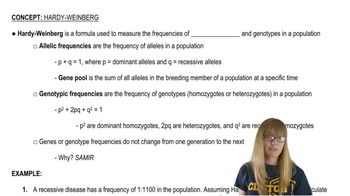
The Hardy-Weinberg Equilibrium is a principle that describes the genetic variation in a population under certain ideal conditions, where allele frequencies remain constant from generation to generation. It assumes no mutation, migration, selection, or genetic drift, and that mating is random. This model provides a baseline to compare real populations against, helping to identify evolutionary changes.
Recommended video:
Guided course
13:04
Hardy Weinberg

Allele Frequency

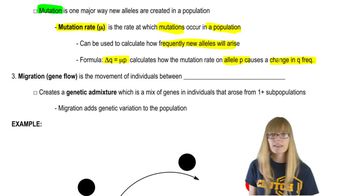
Allele frequency refers to how often a particular allele appears in a population compared to other alleles for the same gene. It is expressed as a proportion or percentage and is crucial for understanding genetic diversity and the potential for evolution within a population. In the context of the question, the frequencies of the four remaining candy colors represent the allele frequencies of a gene.
Recommended video:
Guided course
03:03
New Alleles and Migration

Genotype Frequency

Genotype frequency is the proportion of different genotypes in a population, calculated based on the allele frequencies. In a population with multiple alleles, the expected genotype frequencies can be derived from the allele frequencies using the Hardy-Weinberg formula. This allows researchers to predict the distribution of genotypes, which is essential for understanding genetic variation and inheritance patterns.
Recommended video:
Guided course
07:52
Gamete Genotypes