GOB Chemistry
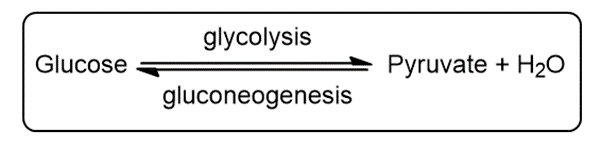
Consider the cycle between glycolysis and gluconeogenesis. The two pathways operate in opposite directions. Identify which pathway is exergonic and which is endergonic.
Which of the four stages of metabolism involves the oxidation of a certain substrate to CO₂ while generating NADH, FADH₂, and a small amount of ATP?
What is the common metabolic product derived from the breakdown of sugars, fats, and proteins?
The following reaction occur during cellular respiration:
Pyruvate → Acetyl CoA + CO2 (ΔG =-29 kJ/mol)
Is this reaction exergonic or endergonic? Does it produce a phosphate group that later yields energy by giving up a phosphate group?
What distinguishes gluconeogenesis from metabolism?
Compare the energy released during the combustion reaction for methane gas (CH4) with its biological oxidation within methanotrophic bacteria. What are the differences in how energy is released and utilized?
Which of the following is an example of an anabolic process?