Skip to main content
GOB Chemistry
My Course
Learn
Exam Prep
AI Tutor
Study Guides
Textbook Solutions
Flashcards
Explore
Try the app
My Course
Learn
Exam Prep
AI Tutor
Study Guides
Textbook Solutions
Flashcards
Explore
Try the app
Back
Bio Chemistry: Cellular Energy and Metabolism
You can tap to flip the card.
Where does the body obtain energy?
You can tap to flip the card.
👆
Where does the body obtain energy?
From the oxidation of food molecules.
Track progress
Control buttons has been changed to "navigation" mode.
1/42
Recommended videos
1:23
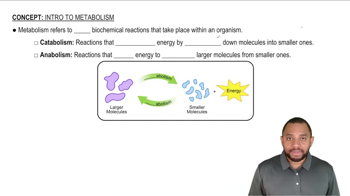
Intro to Metabolism Concept 1
2267
views
4
rank
0:52
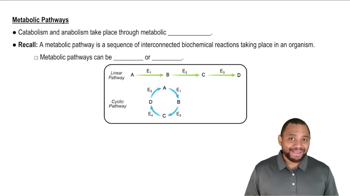
Metabolic Pathways Concept 2
2204
views
1:03
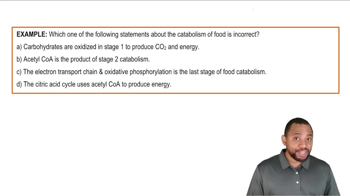
Stages of Catabolism Example 3
2319
views
2
rank
Terms in this set (42)
Hide definitions
Where does the body obtain energy?
From the oxidation of food molecules.
Where does most energy generation occur in eukaryotic cells?
In the mitochondria.
What is an exergonic reaction?
A favorable reaction that releases free energy and can occur spontaneously.
What is an endergonic reaction?
An unfavorable reaction that requires an input of free energy.
What is metabolism?
The sum of all chemical reactions in an organism.
What is catabolism?
The breakdown of molecules, generally releasing energy.
What is anabolism?
The building of larger molecules from smaller ones, generally requiring energy.
What is a metabolic pathway?
A series of connected chemical reactions where the product of one reaction becomes the substrate for the next.
What is the cytosol?
The fluid inside a cell in which organelles are suspended.
What is the mitochondrial matrix?
The innermost compartment of a mitochondrion, where the citric acid cycle occurs.
What happens in the first stage of food catabolism?
Food is digested into smaller molecules that can be absorbed into cells.
What happens in the second stage of food catabolism?
Carbohydrates, lipids, and proteins are broken down through pathways that produce acetyl-CoA.
What is acetyl-CoA?
Acetyl coenzyme A; a molecule that carries a two-carbon acetyl group into the citric acid cycle.
What happens in the third stage of food catabolism?
Acetyl groups are oxidized in the citric acid cycle, producing reduced coenzymes and releasing carbon dioxide.
What happens in the fourth stage of food catabolism?
Electrons from reduced coenzymes pass through the electron-transport chain, supporting ATP production.
What is ATP?
Adenosine triphosphate; the cell’s principal energy-transfer molecule.
How is ATP formed from ADP?
A phosphate group is added to ADP using energy, forming ATP.
How does ATP help power cellular work?
ATP hydrolysis releases energy that can be coupled to energy-requiring processes.
What is a coupled reaction?
A process in which an energy-releasing reaction drives an energy-requiring reaction.
Why are endergonic reactions coupled to exergonic reactions?
The energy released by the exergonic reaction makes the combined process favorable.
What is oxidation?
The loss of electrons.
What is reduction?
The gain of electrons.
What is a coenzyme?
A molecule that assists an enzyme in carrying out a reaction.
How do redox coenzymes function in metabolism?
They cycle between oxidized and reduced forms, carrying electrons between reactions.
What happens when NAD+ is reduced?
It gains electrons and a hydrogen ion to form NADH.
What happens when FAD is reduced?
It gains electrons and hydrogen to form FADH2.
What is the citric acid cycle?
A cyclic pathway that oxidizes acetyl groups and produces reduced coenzymes, carbon dioxide, and GTP.
How many reactions are in the citric acid cycle?
Eight.
Why is the citric acid cycle considered cyclic?
The final reactions regenerate oxaloacetate, which is needed to begin another turn.
What combines with the acetyl group at the start of the citric acid cycle?
Oxaloacetate combines with the acetyl group to form citrate.
How many carbon dioxide molecules are released per acetyl group oxidized in the citric acid cycle?
Two.
What are the reduced coenzymes produced per turn of the citric acid cycle?
Three NADH and one FADH2.
How much GTP is produced per turn of the citric acid cycle?
One GTP, which can be used to make ATP.
What is the electron-transport chain?
A series of protein complexes that transfer electrons and help create a hydrogen-ion gradient.
Where is the electron-transport chain located in eukaryotic cells?
In the inner mitochondrial membrane.
What delivers high-energy electrons to the electron-transport chain?
Reduced coenzymes, including NADH and FADH2.
What is coenzyme Q?
A mobile electron carrier that transfers electrons within the electron-transport chain.
How does electron transport help build a hydrogen-ion gradient?
Energy released as electrons move through the chain is used to pump hydrogen ions across the inner mitochondrial membrane.
What is oxidative phosphorylation?
The production of ATP using the hydrogen-ion gradient generated by electron transport.
What is ATP synthase?
An enzyme that uses the flow of hydrogen ions to produce ATP from ADP and phosphate.
How are electron transport and ATP synthesis coupled?
Electron transport builds a hydrogen-ion gradient, and ATP synthase uses that gradient to make ATP.
What is the final electron acceptor in the electron-transport chain?
Oxygen; it accepts electrons and hydrogen ions to form water.
 BackBack
 1:23