 Back
Enyzmes
 2:14

Terms in this set (45)
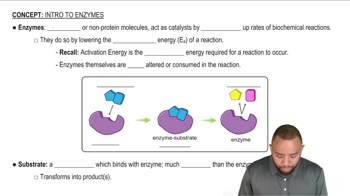
Bio catalyst that speeds up chemical reactions.
New name for the reactant in an enzyme-catalyzed reaction.
Number of substrates converted to product over a period of time.
Nonprotein substance bound to a protein, required for catalytic activity.
*trace metals
Organic cofactor found in redox enzymes, often vitamins.
The protein part of an enzyme without its cofactor or coenzyme.
Apoenzyme with its cofactor/coenzyme, catalytically active enzyme.
Pocket in enzyme where substrate binding and catalysis occur.
Enzymes that catalyze oxidation-reduction reactions.
Enzymes that catalyze the transfer of functional groups between molecules.
Enzymes that catalyze the hydrolysis of chemical bonds.
Enzymes that catalyze the rearrangement of atoms to form isomers.
Enzymes that catalyze the addition or removal of groups to/from double bonds.
Enzymes that catalyze the bonding of two molecules using ATP energy.
Subclass of oxidoreductase that removes 2H from substrate to form double bonds; uses FAD or NAD+ as coenzyme.
Subclass of transferase that transfers phosphoryl groups between substrates.
Subclass of transferase that transfers amino groups between substrates.
Subclass of hydrolase that hydrolyze ester bonds in lipids.
Subclass of hydrolase that hydrolyze peptide bonds in proteins.
Subclass of hydrolase that hydrolyze phosphate ester bonds in DNA/RNA.
Subclass of hydrolase that hydrolyze 1,4 glycosidic bonds in starch.
Inhibitor that resembles the substrate and competes for the active site.
Inhibitor that binds to a separate site on the enzyme; also called allosteric regulator.
Inhibitor that binds to the enzyme-substrate complex but not the active site.
Inhibitor causing covalent modification that permanently inactivates the enzyme.
Regulation by binding at a site other than active site; + increases activity, - decreases activity.
Product inhibits or enhances the first enzyme in a pathway to save energy or increase activity.
Irreversible inhibition by adding a phosphate group on Tyr, Ser, or Thr, causing conformational changes to activate or deactivate enzyme.
Enzymes synthesized in an inactive form that require removal of a protein segment to activate.
Control of enzyme levels by turning the gene for the enzyme on or off.
Hydrophilic vitamins with OH/COOH groups, form coenzymes; include C, B1, B2, B3, B5, B6, B7, B9, B12.
Hydrophobic vitamins with mostly C/H atoms, stored in liver; include A, D, E, K.
Derived from beta-carotene; important for vision and acts as an antioxidant for lipids.
Derived from 7-dehydrocholesterol; important for bone health and growth.
Antioxidant that prevents oxidative damage to vitamin A, LDLs, and cell membranes.
Essential for formation of prothrombin, which is important for blood clotting.
Functions as thiamine pyrophosphate; involved in decarboxylation reactions.
Forms FAD and FMN; involved in redox reactions.
Forms NAD+ and NADP+; involved in redox reactions.
Forms coenzyme A; involved in acetyl group transfer.
Forms pyridoxal phosphate; involved in transamination reactions.
Also called biocytin; functions as a CO2 carrier.
Forms tetrahydrofolate; involved in methyl group transfer.
Forms methylcobalamin; involved in methyl group transfer.
Functions as an antioxidant and is important for collagen synthesis and wound healing.