 Back
Exam 2 Chemistry Key Concepts
 1:09

Terms in this set (27)
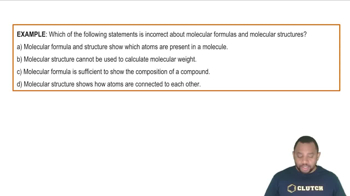
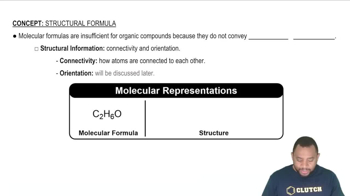
Molecular formula shows types and numbers of atoms. Condensed groups atoms by bonds. Lewis shows all bonds and lone pairs. Skeletal shows carbon skeleton with implied hydrogens.
Alkanes have single bonds, alkenes have double bonds, alkynes have triple bonds between carbons.
Alcohol: -OH group; Amine: -NH2 or derivatives; Ether: R-O-R; Alkyl halide: halogen attached to alkyl; Aromatic: benzene ring structure.
All contain C=O. Amides: C=O attached to N; Carboxylic acids: C=O and -OH; Aldehydes: C=O at end of chain; Ketones: C=O within chain; Esters: C=O adjacent to O-R.
Name longest carbon chain, number to give substituents lowest numbers, use suffixes -ane, -ene, -yne for single, double, triple bonds respectively.
Shorter bonds are generally stronger. Triple bonds are shorter and stronger than double, which are shorter and stronger than single bonds.
Common alkyl groups: methyl (CH3-), ethyl (C2H5-), propyl (C3H7-), named by removing -ane and adding -yl.
Halogens as substituents are named as prefixes: chloro (Cl), bromo (Br), fluoro (F), iodo (I).
Structural isomers differ in connectivity. Stereoisomers have same connectivity but differ in spatial arrangement.
Cis/trans differ by relative positions around double bonds or rings. Chiral molecules have non-superimposable mirror images due to chiral centers.
A chiral center is a carbon bonded to four different groups, leading to non-superimposable mirror images (enantiomers).
Enantiomers are pairs of chiral molecules that are non-superimposable mirror images with identical physical properties except optical activity.
Omega indicates position of first double bond from methyl end. X:X shows number of carbons and double bonds (e.g., 18:1).
Saturated: no double bonds; monounsaturated: one double bond; polyunsaturated: multiple double bonds.
ΔH is heat change. Exothermic releases heat (ΔH negative). Endothermic absorbs heat (ΔH positive).
ΔG negative means spontaneous (exergonic), positive means non-spontaneous (endergonic).
Increase temperature, add more reagents, or use a catalyst.
Synthesis: building molecules; decomposition: breaking down; exchange/displacement: swapping parts.
Includes redox, combustion, addition (hydration, hydrogenation), condensation, and hydrolysis.
Classified by carbon number: triose (3C), tetrose (4C), pentose (5C), hexose (6C).
Aldose has aldehyde group at C1; ketose has ketone group usually at C2.
Enantiomers: mirror images; diastereomers: not mirror images; epimers: differ at one chiral center.
Anomeric carbon is the new chiral center formed in cyclic sugars. Alpha: OH down; Beta: OH up on anomeric carbon.
Two monosaccharides join by condensation, forming a glycosidic bond which can be alpha or beta with specific carbon numbering.
Storage: starch, glycogen; Structural: cellulose, chitin.
Starch is plant glucose storage made of amylose (linear) and amylopectin (branched).
Boyle’s Law: pressure inversely proportional to volume; Charles’ Law: volume proportional to temperature; Gay-Lussac’s Law: pressure proportional to temperature.