 Back
GOB Chemistry Chapter 1: Matter and Measurements

 1:58

Terms in this set (20)
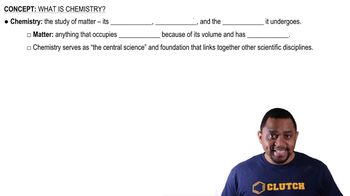
Chemistry is the central science that studies the composition, structure, properties, and changes of matter.
Matter is anything that has mass and occupies space.
Characteristics useful for identifying a substance, such as size, color, temperature, and physical state.
Chemical properties describe how matter behaves or reacts chemically.
Physical change does not alter chemical makeup; chemical change changes the chemical composition.
Matter exists as solid, liquid, or gas.
A substance with uniform chemical composition throughout, either an element or a compound.
A physical blend of substances retaining identities; types are homogeneous (uniform) and heterogeneous (nonuniform).
A fundamental substance that cannot be broken down chemically into simpler substances.
A pure substance that can be broken down into simpler substances by chemical reactions; represented by a chemical formula.
Color change, gas production, heat loss/gain, and formation of a precipitate.
A process involving observation, hypothesis, experimentation, data analysis, and conclusion.
Mass: kilogram (kg), Length: meter (m), Temperature: kelvin (K).
A number expressed as a product of a number between 1 and 10 and a power of 10, useful for very large or small numbers.
Digits in a measurement that are known plus one estimated digit, indicating precision.
Add/subtract: round to fewest decimal places; multiply/divide: round to fewest significant figures.
A problem-solving method using conversion factors to change units.
Energy is the capacity to do work or supply heat; temperature measures average kinetic energy of particles.
The amount of heat needed to raise the temperature of 1 g of a substance by 1°C.
Density is mass per unit volume; specific gravity is the ratio of a substance's density to water's density at the same temperature.