Back

GOB Chemistry: Chemical Bonding and Molecular Structure

Control buttons has been changed to "navigation" mode.
1/21
  • What is an ionic bond?

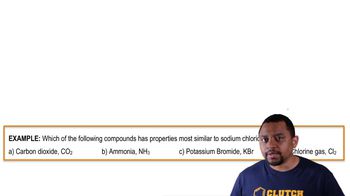
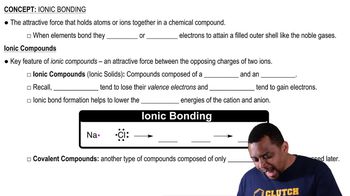
    An ionic bond is the electrostatic attraction between oppositely charged ions formed by the transfer of electrons.
  • What distinguishes ionic compounds from molecular compounds?

    Ionic compounds consist of ions held by ionic bonds, usually between metals and nonmetals, while molecular compounds consist of molecules held by covalent bonds, usually between nonmetals.
  • How do you determine the ionic charge of an element using the periodic table?

    The ionic charge is often determined by the group number: Group 1 forms +1, Group 2 forms +2, Group 17 forms -1, etc., based on the tendency to lose or gain electrons.
  • How do you write the name of a simple ionic compound from its formula?

    Name the cation first, then the anion. For metals with variable charge, use Roman numerals to indicate charge, followed by the anion name with an '-ide' suffix.
  • How do you write the formula for a simple ionic compound from its name?

    Write the symbols for the cation and anion, then balance the total positive and negative charges to get a neutral compound.
  • What is a polyatomic ion?

    A polyatomic ion is a charged species composed of two or more atoms covalently bonded that act as a single ion.
  • Name three common polyatomic ions and their formulas.

    Hydroxide \(\mathrm{OH}^-\), Nitrate \(\mathrm{NO}_3^-\), Sulfate \(\mathrm{SO}_4^{2-}\).
  • How do you write the name of a polyatomic ionic compound from its formula?

    Name the cation first, then the polyatomic ion using its standard name (e.g., sulfate, nitrate).
  • How do you write the formula for a polyatomic ionic compound from its name?

    Write the cation symbol and the polyatomic ion formula, using parentheses if more than one polyatomic ion is needed to balance charge.
  • How do you name ionic compounds with variable charge cations?

    Use Roman numerals in parentheses after the cation name to indicate its charge, e.g., Iron(III) chloride.
  • What is a covalent bond?

    A covalent bond is a chemical bond formed by the sharing of electron pairs between atoms.
  • How do you write the name of a molecular compound from its formula?

    Use prefixes to indicate the number of atoms (mono-, di-, tri-, etc.) and name the elements, ending the second element with '-ide'.
  • How do you write the formula for a molecular compound from its name?

    Use the prefixes to determine the number of each atom and write the corresponding element symbols.
  • What is a Lewis structure?

    A Lewis structure is a diagram showing the bonding between atoms and the lone pairs of electrons in a molecule.
  • How do you represent single, double, and triple bonds in Lewis structures?

    Single bonds are one pair of shared electrons, double bonds are two pairs, and triple bonds are three pairs shared between atoms.
  • What is electronegativity?

    Electronegativity is the tendency of an atom to attract shared electrons in a chemical bond.
  • How does electronegativity determine bond polarity?

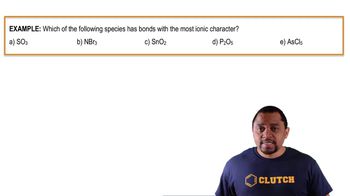
    If the difference in electronegativity is large, the bond is ionic; if moderate, polar covalent; if small or zero, nonpolar covalent.
  • What is VSEPR theory used for?

    VSEPR theory predicts the three-dimensional shape of molecules based on electron pair repulsions around the central atom.
  • Name five common molecular shapes predicted by VSEPR theory.

    Linear, trigonal planar, bent, tetrahedral, and trigonal pyramidal.
  • How do you determine if a covalent molecule is polar?

    A molecule is polar if it has polar bonds and an asymmetrical shape causing a net dipole moment.
  • What types of intermolecular forces exist between molecules?

    Ionic bonds, dipole-dipole attractions, hydrogen bonds, and dispersion (London) forces.