 Back
BackGOB Chemistry Core Concepts
 01:34
01:34
Terms in this set (22)
The three states of matter are solids, liquids, and gases.
Physical properties can be observed without changing the substance, while chemical properties describe a substance's ability to undergo chemical changes.
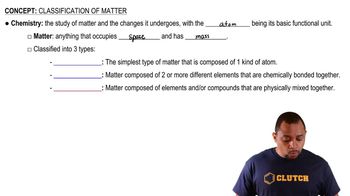
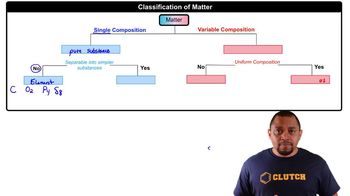
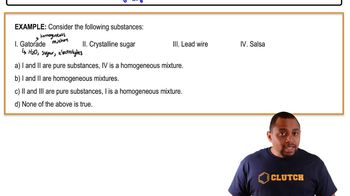
A pure substance has a fixed composition and properties, while a mixture contains two or more substances physically combined.
Elements are pure substances made of one type of atom; compounds are pure substances made of two or more elements chemically combined.
Homogeneous mixtures have uniform composition throughout; heterogeneous mixtures have visibly different parts.
Changes include freezing, melting, boiling, condensation, evaporation, sublimation, and deposition.
A physical change alters form without changing composition; a chemical change produces new substances.
Specific heat is calculated using \(q=mc\Delta T\), where q is heat, m is mass, c is specific heat, and \(\Delta\) T is temperature change.
It shows temperature changes and phase changes of a substance as heat is added or removed.
The Periodic Table is organized into periods, groups, metals, nonmetals, and metalloids.
Metals are typically lustrous, malleable, ductile, and good conductors of heat and electricity.
Nonmetals are usually brittle when solid, poor conductors, and can be gases or solids at room temperature.
Metalloids have properties intermediate between metals and nonmetals and are semiconductors.
Atomic theory states that matter is made of atoms, which are the smallest units of elements retaining their properties.
Atoms consist of protons (+), neutrons (neutral), and electrons (-).
Atomic number = number of protons; mass number = protons + neutrons; atomic mass is the weighted average of isotopes.
Electron configuration describes the arrangement of electrons in an atom's shells and subshells.
Shells are energy levels; subshells are divisions within shells (s, p, d, f); orbitals are regions where electrons are likely found.
Trends include atomic size decreasing across periods, ionization energy increasing across periods, and metallic character decreasing across periods.
Atomic size decreases across a period and increases down a group due to electron shielding and nuclear charge.
Ionization energy is the energy required to remove an electron from an atom in the gas phase.
Metallic character decreases across a period and increases down a group.