What are enzymes and how do they catalyze biochemical reactions?
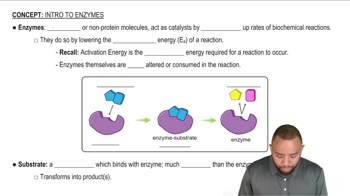
Enzymes are protein or non-protein molecules that act as catalysts by increasing the rate of biochemical reactions. They do this by lowering the activation energy (Ea) required for the reaction.
What is a substrate in enzyme reactions?
A substrate is a reactant molecule that binds to an enzyme. It is usually smaller than the enzyme and is transformed into product(s) during the reaction.
How are enzymes commonly named?
Enzymes are named based on their substrate rather than their structure, often by modifying the substrate name with the suffix -ase.
What determines the systematic naming of enzymes?
The substrate attached and the type of catalyzed reaction determine the systematic name of an enzyme.
How many main classes of enzymes are there and what are they based on?
There are six main classes of enzymes, classified based on the type of reaction they catalyze.
What reaction do oxidoreductases catalyze?
Oxidoreductases catalyze oxidation-reduction (redox) reactions by transferring electrons or hydrogen atoms between molecules.
What is the function of transferases?
Transferases catalyze the transfer of functional groups such as amino or phosphate groups between molecules.
What type of reaction do hydrolases catalyze?
Hydrolases catalyze hydrolysis reactions, breaking bonds by adding water.
What is the role of isomerases?
Isomerases catalyze the creation of an isomer by shifting functional groups to different positions within the same molecule.
What reactions do lyases catalyze?
Lyases catalyze the addition or removal of groups to form or break double bonds without hydrolysis or redox reactions.
What is the function of ligases?
Ligases catalyze the bonding of two molecules together using energy from ATP.
What is an enzyme-substrate complex (ES)?
An enzyme-substrate complex is a temporary intermediate formed when the substrate binds to the enzyme's active site during a reaction.
What are the two models describing enzyme-substrate interaction?
The two models are (1) Lock and Key, where the active site is rigid and fits the substrate exactly, and (2) Induced Fit, where the active site changes shape to accommodate the substrate.
What factors affect enzyme activity?
Enzyme activity is affected by substrate concentration, enzyme concentration, temperature, and pH. Extreme temperature or pH can cause denaturation and loss of function.
What is enzyme inhibition?
Enzyme inhibition is the decrease in enzyme activity caused by an inhibitor molecule that binds to the enzyme, either at the active site (competitive) or elsewhere (noncompetitive).
What distinguishes competitive and noncompetitive inhibition?
Competitive inhibitors bind to the active site blocking substrate binding, while noncompetitive inhibitors bind to a different site causing enzyme shape change and activity loss.
What is allosteric control of enzymes?
Allosteric control involves enzymes with two binding sites: an active site for substrate and an allosteric site for regulators that can activate or inhibit enzyme activity.
What is feedback control in enzyme regulation?
Feedback control is when the end-product of a metabolic pathway acts as a negative allosteric regulator of the enzyme catalyzing the first step, turning the pathway off.
What is covalent modification in enzyme regulation?
Covalent modification regulates enzyme activity by adding or removing chemical groups such as phosphate groups or by activating zymogens through polypeptide cleavage.
What are zymogens?
Zymogens are inactive enzyme precursors that become active enzymes after removal of an extra polypeptide segment by hydrolysis.
 Back
 2:14