Back

GOB Chemistry Exam 1 Review Flashcards

Control buttons has been changed to "navigation" mode.
1/28
  • What is a hypothesis in the scientific method?

    A tentative interpretation or explanation that can be tested by experiments and has the potential to be proven wrong.

  • Define a scientific law.

    A brief statement summarizing many past observations and predicting new ones.

  • What does the law of conservation of mass state in combustion reactions?

    The total mass of reactants equals the total mass of products; gaseous products may escape, but mass is conserved overall.

  • How many significant digits are in the measurement 0.03010 L?

    There are 4 significant digits in 0.03010 L.

  • Convert 0.0049 grams to milligrams.

    0.0049 grams equals 4.9 milligrams.

  • What is the correct scientific notation for 0.00050210?

    5.0210 × 10⁻⁴

  • How many estimated digits are in the measurement 48.93 m?

    The last digit (3) is estimated.

  • What is the density formula and its units?

    Density = mass/volume, typically in g/mL or g/cm3.

  • What is the volume of a cube with sides 11.0 cm in m3?

    Volume = 11.0 × 11.0 × 11.0 cm3 = 1.33 × 10⁻³ m3.

  • Will a plastic block with density 1.3 g/mL float in water (density 1.0 g/mL)?

    No, because the block's density is greater than water's, so it will sink.

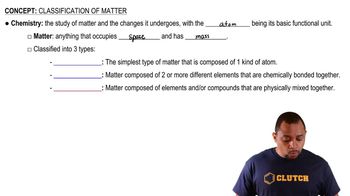
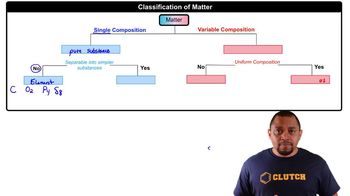
  • What is a pure substance?

    A material composed of only one type of atom or molecule with constant composition.

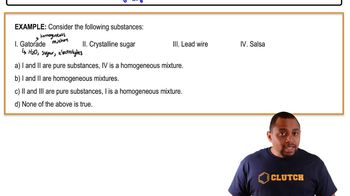
  • What is a homogeneous mixture?

    A mixture with uniform composition throughout, e.g., stainless steel.

  • What is the difference between a physical and chemical change?

    A physical change alters form without changing composition; a chemical change alters composition.

  • What is the Kelvin temperature equivalent of 27°C?

    300 K (Kelvin = Celsius + 273).

  • What is the atomic number and symbol for iron?

    Atomic number 26, symbol Fe.

  • Where are metals located on the periodic table?

    On the left side of the periodic table.

  • What are alkali metals?

    Elements in Group 1A of the periodic table.

  • What is the charge of a potassium ion with 18 electrons?

    K+ (potassium loses one electron to form a +1 ion).

  • What is the electron arrangement for potassium (atomic number 19)?

    2, 8, 8, 1

  • What are valence electrons?

    Electrons in the outermost energy level of an atom.

  • What is the correct formula for calcium sulfate?

    CaSO4

  • Which compound contains covalent bonds: CH4, Kr, KBr, or K?

    CH4 contains covalent bonds.

  • What is the shape of the ammonia molecule (NH3)?

    Trigonal pyramidal

  • What type of intermolecular forces are present in ammonia (NH3)?

    Hydrogen bonds

  • What is sublimation?

    The phase change from solid directly to gas without passing through liquid.

  • What is the main type of energy associated with burning gasoline?

    Chemical energy

  • How many total atoms are in Al2(CO3)3?

    14 atoms

  • What is the charge on phosphate ion?

    3-