 Back
GOB Chemistry Fundamentals
 02:00

Terms in this set (13)
If a substance can be decomposed, is it an element or a compound?
It is classified as an ionic compound (or electrolyte).
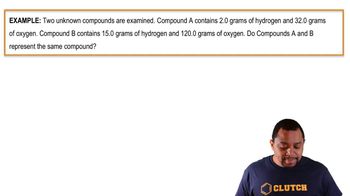
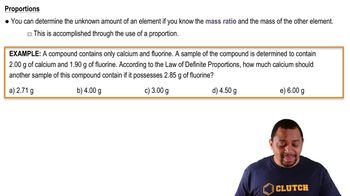
Why is the chemist wrong to say "compound a" (14.0 g N + 16.0 g O) and "compound b" (42.0 g N + 48.0 g O) are two completely different compounds?
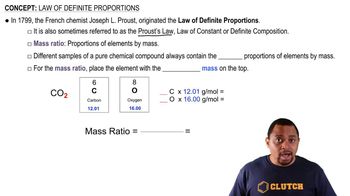
Both experiments use the exact same mass ratio of nitrogen to oxygen (14.0 g : 16.0 g is the same 7:8 ratio as 42.0 g : 48.0 g, just multiplied by 3). By the law of definite proportions, they can be the exact same compound.
All scientists today believe that atoms do, in fact, exist. Has their existence been proven?
No. Science cannot prove anything with 100% certainty, so the existence of atoms has not been proven, even though overwhelming experimental evidence supports it.
If 12.0 g C + 32.0 g O makes 44.0 g CO2, how much CO2 is made from 120.0 g C and 160.0 g O, and what is left over?
220.0 g of CO2 will be made, with 60.0 g of carbon left over. (160.0 g O is 5 times 32.0 g O, so it reacts with 5 x 12.0 g = 60.0 g C to make 5 x 44.0 g = 220.0 g CO2, leaving 120.0 g - 60.0 g = 60.0 g C unused.)
NaNO3 and BaSO4, because they are ionic compounds (formed from a metal and nonmetals), whereas C3H6ClF and CS2 are covalent (nonmetals only) and do not conduct electricity. (Note: In practice, BaSO4 is poorly soluble.)