Boyle's Law states that \(P_1V_1=P_2V_2\), meaning pressure and volume of a gas are inversely proportional at constant temperature.
State Charles' Law.
Charles' Law states that \(\frac{V_1}{T_1}=\frac{V_2}{T_2}\), meaning volume and temperature of a gas are directly proportional at constant pressure.
What does Gay-Lussac's Law describe?
Gay-Lussac's Law states that \(\frac{P_1}{T_1}=\frac{P_2}{T_2}\), meaning pressure and temperature of a gas are directly proportional at constant volume.
Explain the Combined Gas Law.
The Combined Gas Law combines Boyle's, Charles', and Gay-Lussac's laws: \(\frac{P_1V_1}{T_1}=\frac{P_2V_2}{T_2}\), relating pressure, volume, and temperature changes.
What is Avogadro's Law?
Avogadro's Law states that \(\frac{V_1}{n_1}=\frac{V_2}{n_2}\), meaning volume and amount of gas (moles) are directly proportional at constant temperature and pressure.
State Dalton's Law of Partial Pressures.
Dalton's Law states that the total pressure of a gas mixture is the sum of the partial pressures: \(P_{total}=P_1+P_2+P_3+...\).
What are the four basic properties of gases?
The four basic properties are pressure, volume, temperature, and amount of gas (moles).
Define atmospheric pressure.
Atmospheric pressure is the pressure exerted by the weight of air in the atmosphere on a surface.
Convert 1 atm to mmHg and Torr.
1 atm equals 760 mmHg and 760 Torr.
What is the relationship between mmHg and Torr?
1 mmHg is equal to 1 Torr; they are used interchangeably.
Convert 0°C to Kelvin.
0°C equals 273 K.
What is the molar volume of a gas at STP?
At STP, 1 mole of gas occupies 22.4 liters.
How does pressure affect gas volume according to Boyle's Law?
Pressure and volume are inversely proportional; increasing pressure decreases volume if temperature is constant.
How does temperature affect gas volume according to Charles' Law?
Volume and temperature are directly proportional; increasing temperature increases volume if pressure is constant.
How does temperature affect gas pressure according to Gay-Lussac's Law?
Pressure and temperature are directly proportional; increasing temperature increases pressure if volume is constant.
How do you use the Combined Gas Law in calculations?
Use \(\frac{P_1V_1}{T_1}=\frac{P_2V_2}{T_2}\) to find unknown pressure, volume, or temperature when others change.
How is Avogadro's Law applied in gas calculations?
Use \(\frac{V_1}{n_1}=\frac{V_2}{n_2}\) to relate volume changes to moles of gas at constant temperature and pressure.
What is the significance of Dalton's Law in gas mixtures?
It allows calculation of total pressure by summing partial pressures of individual gases in a mixture.
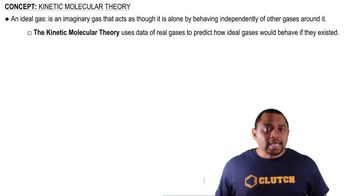
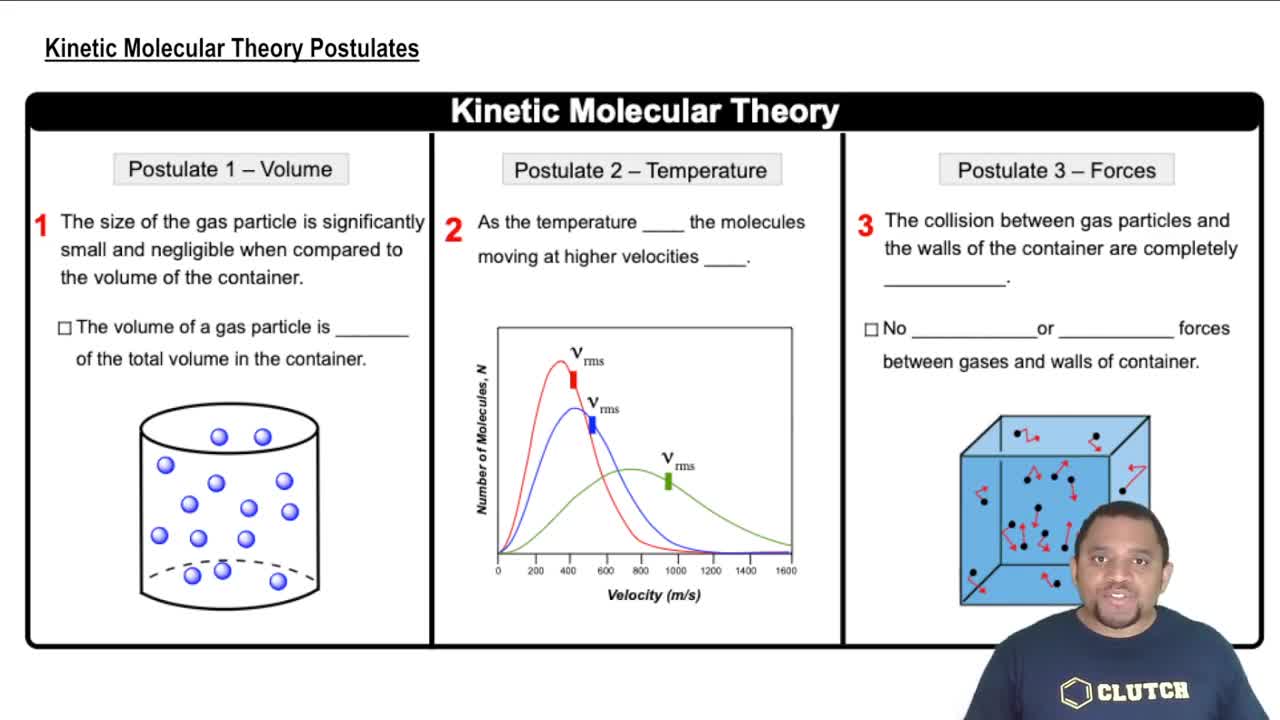
What is the Kinetic Molecular Theory of Gases?
It explains gas behavior based on particle motion, stating gases consist of small particles in constant, random motion with elastic collisions.
List the key conversion factors for gas law calculations.
1 atm = 760 mmHg = 760 Torr; 0°C = 273 K; 1 mole gas = 22.4 L at STP.
 Back
Back
 02:13
02:13