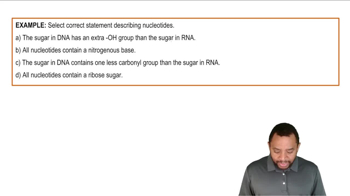
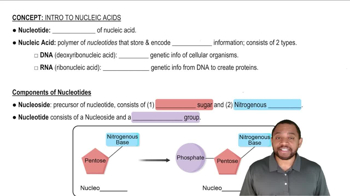
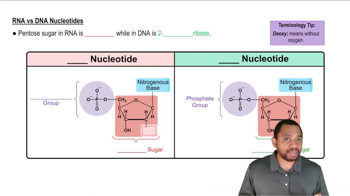
What sugar is found in DNA and how does it differ from RNA sugar?
DNA contains deoxyribose, which lacks an oxygen atom at the 2' carbon compared to ribose in RNA.
How are nucleotides linked together in nucleic acids?
Nucleotides are linked by phosphodiester bonds between the 3' hydroxyl of one sugar and the 5' phosphate of the next.
What is the directionality convention for writing nucleic acid sequences?
Sequences are written from the 5' end to the 3' end, reflecting the orientation of the sugar-phosphate backbone.
What are the major structural differences between DNA and RNA?
DNA has deoxyribose sugar, uses thymine (T), and is usually double-stranded. RNA has ribose sugar, uses uracil (U), and is usually single-stranded.
Describe the double helix structure of DNA.
DNA is a double-stranded helix with strands running antiparallel. The phosphate backbone is on the outside, and bases pair inside perpendicular to the backbone.
Which base pairs form hydrogen bonds in DNA and how many bonds do they form?
Adenine (A) pairs with Thymine (T) via 2 hydrogen bonds, and Guanine (G) pairs with Cytosine (C) via 3 hydrogen bonds.
What forces stabilize the DNA double helix besides hydrogen bonding?
Dispersion forces from stacked aromatic bases (base stacking) provide significant stabilization to the helix.
How do proteins generally interact with DNA?
Proteins interact with DNA mainly through ionic interactions between positively charged amino acids (Arg, Lys, His) and the negatively charged phosphate backbone.
What is chromatin and how is DNA packaged in the nucleus?
Chromatin is DNA compacted with proteins into an orderly tangle. DNA wraps around histone proteins rich in basic amino acids to form nucleosomes.
What is the role of histones in DNA packaging?
Histones contain positively charged amino acids that form salt bridges with DNA phosphates, allowing tight DNA wrapping and compaction.
Define a gene and a chromosome.
A gene is a DNA segment that encodes a single polypeptide. A chromosome is a highly compacted linear DNA-protein complex visible during cell division.
What are Chargaff's rules?
In double-stranded DNA, the amount of adenine equals thymine, and guanine equals cytosine, reflecting base pairing complementarity.
What is the reverse complement of a DNA sequence?
The reverse complement is the sequence complementary to the original strand, written in the opposite 5' to 3' direction, reflecting antiparallel strands.
Why is DNA complementarity important for replication?
Complementarity allows each strand to serve as a template for accurate copying, ensuring faithful DNA replication.
What is a mutagen and how can it affect DNA?
A mutagen is an agent that causes mutations by altering DNA bases, potentially changing base pairing and propagating errors during replication.
Explain the example of cytosine deamination mutation.
Cytosine can be deaminated to uracil, which pairs with adenine instead of guanine, causing a mutation that can be propagated if unrepaired.
What is the Central Dogma of molecular biology?
The Central Dogma describes information flow: DNA is replicated to DNA, transcribed to RNA, and translated to protein.
What is semiconservative replication?
Each new DNA double helix contains one original (old) strand and one newly synthesized strand, preserving genetic information.
 Back
 1:34