 Back
BackGOB Chemistry: Organic Compounds and Alkanes
 1:29
1:29
Terms in this set (20)
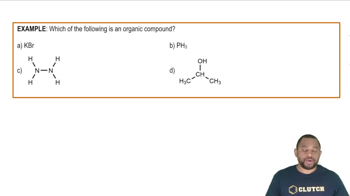
An organic compound always contains carbon and hydrogen atoms and may also include oxygen, sulfur, nitrogen, phosphorus, or halogens.
Organic compounds typically have covalent bonds, low melting and boiling points, are flammable, and are not soluble in water.
Inorganic compounds often have high melting and boiling points, are usually soluble in water if ionic, and do not burn easily.
A hydrocarbon is an organic compound containing only carbon and hydrogen atoms.
A saturated hydrocarbon has only single bonds between carbon atoms.
Methane has a carbon atom bonded to four hydrogens with single covalent bonds, forming a tetrahedral shape with bond angles of 109°.
Organic compounds can be shown as expanded structural formulas, condensed structural formulas, or line-angle structural formulas.
A condensed structural formula groups each carbon atom with its attached hydrogens, using subscripts to indicate the number of hydrogens.
A line-angle formula shows carbon atoms as ends and corners of zigzag lines, with hydrogens implied to complete four bonds per carbon.
Alkanes are named using prefixes for the number of carbons (meth-, eth-, prop-, etc.) and end with -ane.
Each carbon in butane has four single covalent bonds, resulting in a tetrahedral shape.
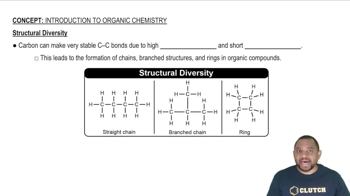
Carbon atoms form strong covalent bonds with each other, allowing long, stable chains and diverse structures.
Cycloalkanes are cyclic alkanes with two fewer hydrogen atoms than their open-chain counterparts and are named with the prefix cyclo-.
Name the longest carbon chain as the parent, number from the end nearest a substituent, and list substituents alphabetically with their position numbers.
Alkyl groups are carbon branches named with an -yl ending; halo substituents are halogen atoms named as fluoro, chloro, bromo, or iodo.
Number the main chain from the end nearest the first substituent to give the lowest possible numbers to substituents.
The substituent name is placed before the cycloalkane name without a number if only one substituent is present.
Haloalkanes are alkanes where a halogen atom replaces a hydrogen atom, named by listing halo substituents alphabetically with their carbon position.
Structural isomers have the same molecular formula but different arrangements of atoms and bonding order.
Butane has two isomers: a straight chain (butane) and a branched chain (isobutane).