 Back
BackGOB Chemistry Test 1 Review Flashcards
 01:34
01:34
Terms in this set (20)
The three states of matter are solids, liquids, and gases.
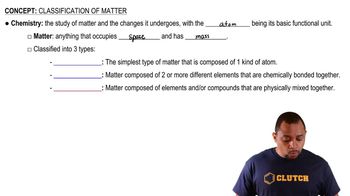
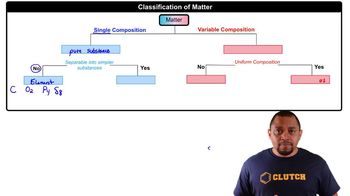
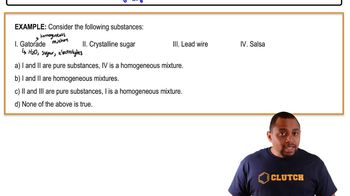
Matter is classified as pure substances or mixtures. Pure substances include elements and compounds. Mixtures can be homogeneous or heterogeneous.
A physical change alters the form or appearance without changing composition. A chemical change results in a new substance with different properties.
Changes of state include freezing, melting, boiling, condensation, evaporation, sublimation, and deposition.
Specific heat is the amount of heat required to raise the temperature of 1 gram of a substance by 1 degree Celsius.
A heating or cooling curve shows temperature changes and phase changes of a substance as heat is added or removed, including plateaus at phase transitions.
Examples: Aluminum (Al), Carbon (C), Oxygen (O), Gold (Au), Nitrogen (N).
The Periodic Table is organized into periods (rows), groups (columns), and includes metals, nonmetals, and metalloids.
Metals are typically lustrous, malleable, ductile, and good conductors of heat and electricity.
Nonmetals are usually brittle when solid, lack luster, and are poor conductors of heat and electricity.
Metalloids have properties intermediate between metals and nonmetals and are semiconductors.
Atomic theory states that matter is composed of atoms, which are the smallest units of elements retaining their properties.
Atoms consist of protons (+1 charge), neutrons (neutral), and electrons (-1 charge).
Atomic number = number of protons; mass number = protons + neutrons; atomic mass is the weighted average of isotopes.
Electron configuration describes the arrangement of electrons in an atom's shells and subshells.
Shells are energy levels, subshells are divisions within shells (s, p, d, f), and orbitals are regions where electrons are likely found.
Atomic size decreases across a period and increases down a group in the Periodic Table.
Ionization energy generally increases across a period and decreases down a group.
Metallic character decreases across a period and increases down a group.
The Periodic Table organizes elements by increasing atomic number and similar properties, helping predict element behavior.