 Back
GOB Chemistry - Thermochemistry Key Concepts
 01:26


Terms in this set (22)
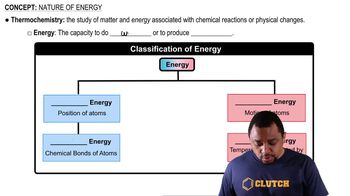
Energy is the ability to do work or transfer heat.
Kinetic energy is the energy an object possesses due to its motion, given by \(E_k=\frac{1}{2}mv^2\).
Potential energy is energy due to an object's position or chemical composition, especially electrostatic potential energy \(E_{el} = \frac{kQ_1Q_2}{d}\).
The SI unit is the joule (J). The calorie (cal) is a non-SI unit where 1 cal = 4.184 J.
Energy is neither created nor destroyed; total energy of the universe is constant. Energy lost by the system is gained by the surroundings, and vice versa.
Internal energy is the sum of all kinetic and potential energies of the system's components.
ΔE = E_final − E_initial; it represents energy absorbed or released by the system.
ΔE = q + w, where q is heat exchanged and w is work done on or by the system.
q > 0 means system gains heat; w > 0 means work done on system; ΔE > 0 means net gain of energy by system.
Endothermic: heat absorbed, ΔH > 0. Exothermic: heat released, ΔH < 0.
A state function depends only on the current state, not the path taken. Internal energy (E) is a state function.
No, heat (q) and work (w) are path-dependent and not state functions.
Work done, w = −PΔV, where P is pressure and ΔV is volume change.
Enthalpy is H = E + PV, the internal energy plus pressure-volume product.
At constant pressure, ΔH = q_p, the heat gained or lost by the system.
ΔH = H_products − H_reactants; it represents heat change during a chemical reaction.
Calorimetry is the measurement of heat flow during chemical reactions or physical changes.
Specific heat is the energy required to raise 1 g of a substance by 1 K (or 1 °C).
q = m × C_s × ΔT, where m is mass, C_s is specific heat, and ΔT is temperature change.
Hess's Law states that total enthalpy change for a reaction is the sum of enthalpy changes for individual steps.
ΔH_f° is the enthalpy change when 1 mole of a compound forms from its elements in their standard states.
ΔH = Σ nΔH_f°(products) − Σ mΔH_f°(reactants), where n and m are stoichiometric coefficients.