 Back
GOB Chemistry: VSEPR and Molecular Shape
 00:45

Terms in this set (20)
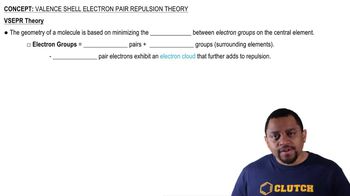
VSEPR stands for Valence Shell Electron Pair Repulsion theory.
Electron pairs around a central atom repel each other and arrange to minimize repulsion, determining molecular shape.
The number of bonding and lone electron pairs around the central atom determines the molecular shape.
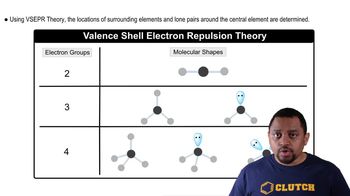
The shape is linear with a bond angle of 180°.
The shape is trigonal planar with bond angles of 120°.
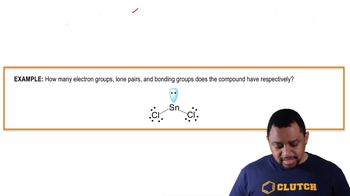
The shape is bent or angular, with bond angles slightly less than 120°.
The shape is tetrahedral with bond angles of 109.5°.
The shape is trigonal pyramidal with bond angles slightly less than 109.5°.
The shape is bent with bond angles around 104.5°.
The shape is trigonal bipyramidal with bond angles of 90° and 120°.
The shape is octahedral with bond angles of 90°.
Lone pairs repel more strongly than bonding pairs, reducing bond angles between atoms.
Electron pairs repel due to their negative charges, seeking to maximize distance to minimize repulsion.
Electron pair geometry includes all electron pairs; molecular geometry considers only atoms.
The shape is see-saw if 5 electron pairs total, or distorted tetrahedral if 4 pairs total.
By determining shape, VSEPR shows if dipoles cancel or add, predicting molecular polarity.
The shape is t-shaped with bond angles less than 90°.
The shape is linear with bond angles of 180°.
Multiple bonds count as one electron domain but can slightly affect bond angles due to increased electron density.
There are 5 electron domains around the central atom.