 Back
lec. 10 GOB Chemistry: Enzyme Classification & Regulation
 2:14

Terms in this set (20)
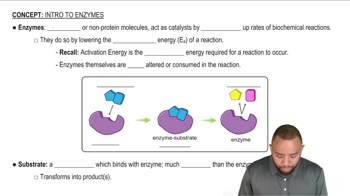
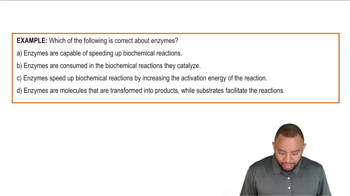
An enzyme is a biological catalyst, typically a protein or RNA, that speeds up biochemical reactions. Enzyme names usually end in "ase" and are named after their substrate.
The substrate is the reactant molecule upon which an enzyme acts to form a product.
The turnover number is the number of substrate molecules converted to product by an enzyme per unit time.
Cofactors are nonprotein substances (often trace metals) required for enzyme activity. Coenzymes are organic cofactors, often vitamins or their derivatives, involved in redox reactions.
An apoenzyme is the protein part of an enzyme without its cofactor/coenzyme. A holoenzyme is the catalytically active enzyme with its cofactor/coenzyme bound.
Enzymes speed up reactions by proximity effect, orientation effect, energy effect (lowering activation energy by bond strain), and catalytic effect (providing functional groups for catalysis).
Oxidoreductases, Transferases, Hydrolases, Isomerases, Lyases, and Ligases.
Oxidoreductases catalyze oxidation-reduction reactions, often requiring coenzymes like NAD+ or FAD.
Transferases transfer functional groups such as amino or phosphoryl groups between substrates. Examples include kinases and transaminases.
Hydrolases catalyze hydrolysis reactions breaking bonds by adding water. Subclasses include lipases, proteases, nucleases, and amylases.
Isomerases catalyze the rearrangement of atoms within a molecule to form isomers.
Lyases catalyze the addition or removal of small molecules to or from double bonds without hydrolysis or oxidation.
Ligases catalyze bond formation between two molecules coupled with ATP hydrolysis to provide energy.
Specific enzymes catalyze one reaction for a single substrate. Nonspecific enzymes catalyze a reaction for a group of similar substrates.
The induced fit model describes substrate binding causing a conformational change in the enzyme, improving binding and catalysis, unlike the rigid lock-and-key model.
Enzyme activity increases with temperature up to an optimum, beyond which activity decreases due to denaturation.
Each enzyme has an optimum pH where activity is maximal; deviations can reduce activity by affecting enzyme structure or charge.
Increasing enzyme concentration increases reaction rate linearly if substrate is in excess.
Reaction rate increases with substrate concentration until the enzyme becomes saturated and rate plateaus at maximum velocity.
Enzymes are not permanently changed; they may form transient complexes but return to their original state after the reaction.