 Back
lec 12 GOB Chemistry: Nucleic Acid Structure and Function
 1:34

Terms in this set (20)
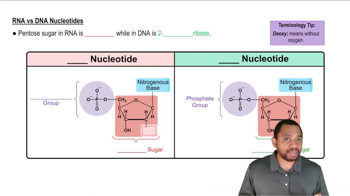
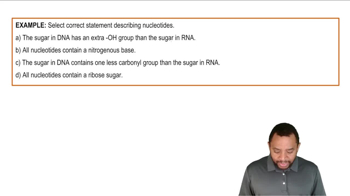
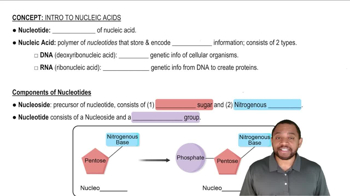
Heterocyclic nitrogenous base, sugar (ribose or deoxyribose), and phosphate group.
A nucleoside consists of a sugar and a nitrogenous base, while a nucleotide also includes one or more phosphate groups.
Purines (adenine and guanine) and pyrimidines (cytosine, thymine in DNA, uracil in RNA).
Thymine (T) is found only in DNA; Uracil (U) is found only in RNA.
DNA contains deoxyribose (lacking an OH at carbon 2), and RNA contains ribose.
By phosphodiester bonds between the 3' hydroxyl of one sugar and the 5' phosphate of the next, forming a sugar-phosphate backbone.
Sequences are written from the 5' end to the 3' end.
Double helix with antiparallel strands, phosphate backbone on the outside, bases paired inside, and planar bases perpendicular to backbone.
A-T pairs form 2 hydrogen bonds, and G-C pairs form 3 hydrogen bonds.
Dispersion forces (stacking interactions) between aromatic bases provide most of the structural stability.
Through ionic interactions between positively charged amino acids (Arg, Lys, His) and negatively charged phosphate groups on DNA.
Chromatin is the compact, orderly tangle of DNA and proteins (including histones) present in non-dividing cells.
A nucleosome is DNA wrapped around histone proteins, forming the basic unit of chromatin structure.
Because these basic amino acids are positively charged and form electrostatic salt bridges with negatively charged DNA phosphates.
In double-stranded DNA, the amount of adenine equals thymine, and the amount of guanine equals cytosine.
The sequence complementary to the original strand, written in the opposite 5' to 3' direction, pairing A-T and G-C.
Each strand serves as a template to synthesize a new complementary strand, ensuring accurate copying of genetic information.
Information flows from DNA to RNA (transcription) and from RNA to protein (translation).
Each new DNA double helix contains one original (parental) strand and one newly synthesized strand.
Mutations can be caused by mutagens like UV radiation or oxidative damage, altering base pairing and potentially propagating during replication.