 Back
lecture 11
 2:04

Terms in this set (23)
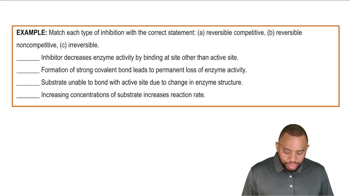
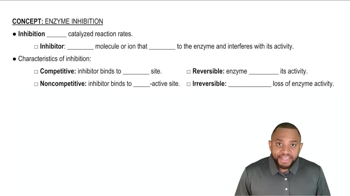
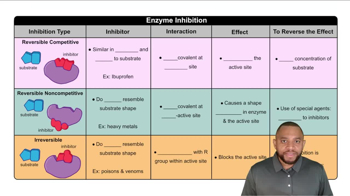
Competitive inhibition occurs when an inhibitor resembles the substrate and competes for the same active site on the enzyme.
Noncompetitive inhibition involves an inhibitor binding to a separate site on the enzyme, changing the active site shape and preventing substrate binding.
Uncompetitive inhibition occurs when the inhibitor binds only to the enzyme-substrate complex, not to the free enzyme.
Irreversible inhibition involves covalent modification of the enzyme, permanently inactivating it.
Competitive inhibition increases Km (decreases affinity) but does not change Vmax.
Noncompetitive inhibition lowers Vmax but does not change Km.
Uncompetitive inhibition lowers both Km and Vmax by the same ratio.
Allosteric regulation involves binding of molecules at sites other than the active site, which can either activate (positive) or inhibit (negative) enzyme activity.
Feedback control uses a product of a metabolic pathway as an allosteric regulator to modulate the activity of an enzyme earlier in the pathway.
Covalent modification involves adding or removing chemical groups (e.g., phosphate) to amino acid residues, altering enzyme activity.
Zymogens are inactive enzyme precursors that require cleavage of a protein segment to become active enzymes.
Genetic control regulates enzyme levels by turning genes on or off, affecting enzyme synthesis.
Fat-soluble vitamins are hydrophobic, stored in the liver, and mainly composed of carbon and hydrogen. Water-soluble vitamins are hydrophilic, contain OH and COOH groups, and are not stored in the body.
Fat-soluble vitamins include A (retinol), D (calciferol), E (α-tocopherol), and K (phylloquinone).
Water-soluble vitamins include C (ascorbic acid) and the B-complex vitamins (B1, B2, B3, B5, B6, B7, B9, B12).
A coenzyme is an organic molecule derived from vitamins that assists enzymes in catalysis by binding to the active site.
Most water-soluble vitamins, especially B-complex vitamins and vitamin C, become coenzymes.
Vitamin A (retinol) supports vision, cell growth, differentiation, and acts as an antioxidant for lipids.
Vitamin D (calciferol) is essential for bone growth by increasing calcium and phosphate absorption and retention.
Vitamin E (α-tocopherol) is a strong antioxidant that prevents oxidative damage to lipids and cell membranes.
Vitamin K (phylloquinone) is required for prothrombin formation, essential in blood clotting and bone metabolism.
Elevated levels of specific enzymes like AST, ALT, LDH, and CK in blood can indicate damage to liver, heart, or other organs.
Lateral flow assays use antibodies conjugated to tags to bind specifically to SARS-CoV-2 spike proteins for antigen detection.