 Back
lecture 12
 1:34

Terms in this set (20)
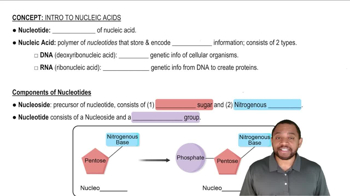
Heterocyclic nitrogenous base, sugar (ribose or deoxyribose), and phosphate group.
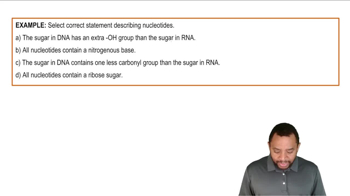
A nucleoside consists of a sugar and a nitrogenous base, while a nucleotide also includes one or more phosphate groups.
Purines (adenine, guanine) and pyrimidines (cytosine, thymine in DNA, uracil in RNA).
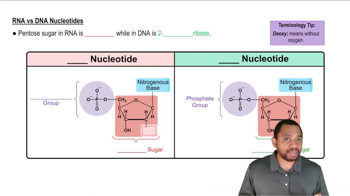
DNA contains deoxyribose, which lacks an oxygen atom at the 2' carbon compared to ribose in RNA.
By phosphodiester bonds between the 3' hydroxyl of one sugar and the 5' phosphate of the next, forming a sugar-phosphate backbone.
Sequences are written from the 5' end to the 3' end, reflecting the orientation of the sugar-phosphate backbone.
DNA has deoxyribose, uses thymine (T), and is usually double-stranded. RNA has ribose, uses uracil (U), and is usually single-stranded.
Hydrogen bonding between complementary bases and dispersion (stacking) forces between aromatic bases stabilize the helix.
A-T pairs form 2 hydrogen bonds, while G-C pairs form 3 hydrogen bonds, making G-C pairs more stable.
Two DNA strands run in opposite directions: one strand runs 5' to 3', the other 3' to 5'.
In double-stranded DNA, the amount of adenine equals thymine, and the amount of guanine equals cytosine.
The sequence formed by taking the complement of each base (A-T, C-G) and reversing the strand direction (3' to 5' becomes 5' to 3').
Histones are positively charged proteins that DNA wraps around to form nucleosomes, compacting DNA into chromatin.
Arginine (Arg) and lysine (Lys) are abundant because their positive charges interact electrostatically with negatively charged DNA phosphates.
Information flows from DNA to RNA to protein via replication, transcription, and translation.
Each new DNA double helix contains one original (parental) strand and one newly synthesized strand.
Mutations can be caused by mutagens like UV radiation or chemical agents, leading to base changes that may be propagated during replication.
Because cytosine can spontaneously deaminate to uracil, DNA repair enzymes recognize uracil as a mutation and remove it to maintain fidelity.
Specific patterns of hydrogen bond donors and acceptors on bases enable complementary base pairing and DNA double helix stability.
Proteins read unique patterns of hydrogen bond donors and acceptors in the major groove of DNA to bind sequence-specifically.