Skip to main content
GOB Chemistry
My Course
Learn
Exam Prep
AI Tutor
Study Guides
Textbook Solutions
Flashcards
Explore
Try the app
My Course
Learn
Exam Prep
AI Tutor
Study Guides
Textbook Solutions
Flashcards
Explore
Try the app
Back
Naming Ionic Compounds - GOB Chemistry
You can tap to flip the card.
Order of ions in ionic formulas and names
You can tap to flip the card.
👆
Order of ions in ionic formulas and names
The cation (positive ion) is always listed first, followed by the anion (negative ion) in both formulas and names.
Track progress
Control buttons has been changed to "navigation" mode.
1/20
Recommended videos
Guided course
01:52
Naming Ionic Compounds
10870
views
78
rank
Guided course
01:01
Naming Ionic Compounds Example 1
10413
views
78
rank
Guided course
02:11
Naming Ionic Compounds
14526
views
126
rank
Terms in this set (20)
Hide definitions
Order of ions in ionic formulas and names
The cation (positive ion) is always listed first, followed by the anion (negative ion) in both formulas and names.
Naming main group cations
Name the cation by the element name only, e.g., Na+ is 'sodium'. The charge is implicit and not stated.
Naming polyatomic cations
Use the name of the polyatomic ion as given, e.g., NH4+ is 'ammonium'. The charge and formula are implicit.
IUPAC naming for transition metal cations
Name the element plus the charge in Roman numerals in parentheses, e.g., Fe3+ is 'iron (III)'.
Classical naming for transition metal cations
Use Latin-based names for different charges, e.g., Fe3+ is 'ferric', Fe2+ is 'ferrous'. This system is mostly used in medicine.
Exceptions where charge is not specified for transition metals
Silver (Ag+) and zinc (Zn2+) only have one stable charge, so no charge is specified in their names.
Naming main group anions
Name the element with an -ide suffix, e.g., O2- is 'oxide', Cl- is 'chloride'. The charge is implicit.
Naming polyatomic anions
Use the name of the polyatomic ion as given, e.g., OH- is 'hydroxide'. The charge and formula are implicit.
General rule for naming ionic compounds
Name the cation first, then the anion, separated by a space, e.g., K3N is 'potassium nitride'.
Naming K3N
K+ is potassium, N3- is nitride, so the compound is named 'potassium nitride'.
Naming Cu(OH)2
Cu2+ is copper (II) or cupric, OH- is hydroxide, so the compound is 'copper (II) hydroxide' or 'cupric hydroxide'.
Steps to determine ionic formula from compound name
Identify symbols, determine cation and anion charges, then find the lowest ratio to balance charges to zero.
Formula for magnesium sulfate
Mg2+ and SO42- charges balance 1:1, so formula is MgSO4.
Formula for copper (I) sulfite
Cu+ and SO32- require 2 Cu+ ions per sulfite ion, formula is Cu2SO3.
Why specify charge for transition metals in names?
Transition metals can have multiple charges, so the charge must be indicated to avoid ambiguity.
What suffix is used for main group anions?
The suffix '-ide' is added to the element name to form the anion name.
What is implicit in the name of an ion?
The fact that it is an ion and its charge are understood and do not need to be explicitly stated.
Difference between IUPAC and classical naming for transition metals
IUPAC uses Roman numerals for charge; classical uses Latin-based names for different charges.
Why learn classical names if outdated?
Classical names are still used in the medical community and on product labels.
How to name polyatomic ions in compounds
Use the polyatomic ion's given name directly without adding 'ion' or charge.
 BackBack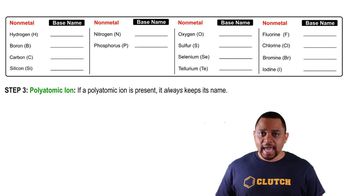
 01:52
01:52