 Back
BackPublic uplod_updated

 1:58
1:58
Terms in this set (23)
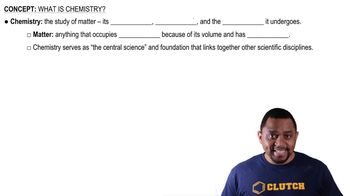
Chemistry is the study of matter, its composition, structure, and the changes it undergoes.
Matter is anything that occupies space because of its volume and has mass.
Element: simplest matter with one kind of atom.
Compound: two or more different elements chemically bonded.
Mixture: physical combination of elements and/or compounds.
A procedure to ask questions, test ideas, and build scientific knowledge.
Make an observation, ask a question, formulate hypothesis & prediction, design & conduct experiment, collect & interpret data, draw conclusions, peer review & publish.
Hypothesis: testable explanation.
Theory: well-supported explanation.
Law: provably consistent phenomenon.
Changes in physical state without changing composition, e.g., melting or dissolving.
Changes that alter chemical composition, forming new substances, e.g., rusting or burning.
Reversible: can restore original structure (phase changes).
Irreversible: permanent change (chemical reactions).
A property observed during a chemical reaction that changes the substance, e.g., reactivity with oxygen.
A measurable property describing a substance's state without changing its chemical structure, e.g., density or color.
Temperature: average kinetic energy of particles.
Heat: transfer of thermal energy from hot to cold.
Amount of heat required to change a substance's temperature.
Heat required to raise 1 gram of a substance by 1 Kelvin.
A way to express very large or small numbers as a coefficient times 10 raised to an exponent.
Standard units for physical quantities like mass (kg), length (m), time (s), temperature (K), amount of substance (mol), and electric current (A).
Multipliers for base units, e.g., kilo (103), milli (10-3), micro (10-6).
Digits in a number that contribute to its precision, including all certain digits plus one estimated digit.
Result should have the same number of significant figures as the factor with the least sig figs.
Result should have the same number of decimal places as the number with the least decimal places.
A method to convert units by multiplying by conversion factors to cancel unwanted units.
Density is mass per unit volume, usually g/cm3 for solids/liquids and g/L for gases.
The ratio of a substance's density to the density of water at the same temperature; it is unitless.