Intermediate Algebra
My Course
Learn
AI Tutor
Study Guides
Flashcards
Explore
Try the app
My Course
Learn
AI Tutor
Study Guides
Flashcards
Explore
Try the app
Back
Absolute Value Equations quiz
You can tap to flip the card.
What does the absolute value of a number represent?
You can tap to flip the card.
👆
What does the absolute value of a number represent?
The absolute value of a number represents its distance from zero on the number line, which is always non-negative.
Track progress
Control buttons has been changed to "navigation" mode.
1/15
Related flashcards
Recommended videos
Absolute Value Equations definitions
Absolute Value Equations
15 Terms
04:48
Solving Absolute Value Equations
101
views
2
rank
02:21
Solving Absolute Value Equations Special Cases
95
views
1
rank
03:51
Solving Equations Involving 2 Absolute Values Example 3
55
views
1
rank
Terms in this set (15)
Hide definitions
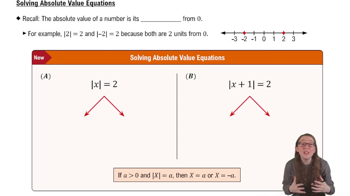
What does the absolute value of a number represent?
The absolute value of a number represents its distance from zero on the number line, which is always non-negative.
How do you solve an equation of the form |x| = a when a is positive?
You rewrite it as two equations: x = a and x = -a, then solve both for x.
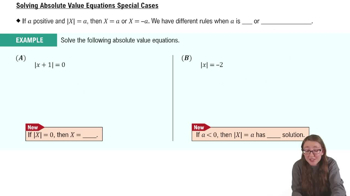
What is the solution to |x| = 0?
The solution is x = 0, since zero is the only number with zero distance from zero.
What happens if you have an equation |x| = a where a is negative?
There is no solution, because absolute value cannot be negative.
What is the first step when solving an absolute value equation?
The first step is to isolate the absolute value expression on one side of the equation.
How do you solve |x + 1| = 2?
Set x + 1 = 2 and x + 1 = -2, then solve to get x = 1 and x = -3.
Why do you rewrite an absolute value equation as two equations?
Because the expression inside the absolute value could be equal to the positive or negative value of the number on the other side.
What is the solution set for |x| = 2?
The solution set is {2, -2}.
How do you solve |x + 1| + 3 = 5?
First, subtract 3 from both sides to isolate the absolute value, then solve |x + 1| = 2 as two separate equations.
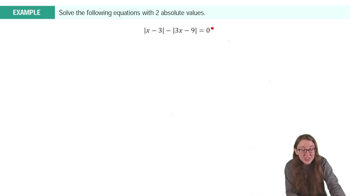
What do you do if an absolute value equation has two absolute values, like |x + 1| = |2x - 4|?
Set up two equations: x + 1 = 2x - 4 and x + 1 = -(2x - 4), then solve both.
How do you set up the second equation when solving |x + 1| = |2x - 4|?
Set x + 1 equal to the negative of the other expression: x + 1 = -(2x - 4).
What are the solutions to |x + 1| = |2x - 4|?
The solutions are x = 5 and x = 1.
Why is it important to check for extraneous solutions in absolute value equations?
Because sometimes the process of solving can introduce solutions that don't satisfy the original equation.
What does it mean to 'isolate the absolute value' in an equation?
It means to get the absolute value expression alone on one side of the equation before applying the rules for solving.
What is the general rule for solving |expression| = a?
Rewrite as two equations: expression = a and expression = -a, then solve both for the variable.