Skip to main content
Intermediate Algebra
My Course
Learn
Exam Prep
AI Tutor
Study Guides
Flashcards
Explore
Try the app
My Course
Learn
Exam Prep
AI Tutor
Study Guides
Flashcards
Explore
Try the app
Back
Exponential Functions definitions
You can tap to flip the card.
Exponential Function
You can tap to flip the card.
👆
Exponential Function
A mathematical expression with a constant positive base not equal to 1, raised to a variable power.
Track progress
Control buttons has been changed to "navigation" mode.
1/15
Related flashcards
Related practice
Recommended videos
Exponential Functions quiz
Exponential Functions
15 Terms
Exponential Functions
11. Inverse, Exponential, & Logarithmic Functions
5 problems
Topic
AllySteele
Introduction to Logarithmic Functions
11. Inverse, Exponential, & Logarithmic Functions
5 problems
Topic
ErnestBlazevic
11. Inverse, Exponential, & Logarithmic Functions
4 topics
12 problems
Chapter
ZacharyFrye
Guided course
04:25
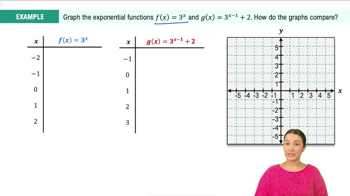
Graphs of Exponential Functions Example 3
52
views
2
rank
Guided course
04:06
Graphs of Exponential Functions Example 4
45
views
2
rank
Guided course
07:54
Graphs of Exponential Functions
77
views
3
rank
Terms in this set (15)
Hide definitions
Exponential Function
A mathematical expression with a constant positive base not equal to 1, raised to a variable power.
Base
A fixed, positive number in an exponential expression that is raised to a variable exponent.
Exponent
A variable or expression indicating how many times the base is multiplied by itself.
Power
The entire expression in the exponent, which may include variables and constants.
Polynomial Function
An algebraic expression with variable bases and fixed exponents, distinct from exponential functions.
Fractional Base
A constant positive base in an exponential function that is a fraction, such as 2/3.
Negative Exponent
An exponent less than zero, resulting in the reciprocal of the base raised to the positive value.
Reciprocal
A value obtained by dividing 1 by a given number, often used when handling negative exponents.
Caret Key
A calculator symbol (^) used to indicate exponentiation when entering exponential expressions.
Variable
A symbol, such as x, representing a value that can change within an exponential function.
Constant
A fixed value, often used as the base in exponential functions, which does not change.
Graph
A visual representation of an exponential function, showing how the output changes as the exponent varies.
Evaluation
The process of substituting values for the exponent and calculating the result of an exponential function.
Parentheses
Symbols used in calculators to clarify the order of operations when entering exponential expressions.
Calculator
A tool used to compute exponential values, especially for non-integer or large exponents.
 BackBack


 04:25
04:25