Intermediate Algebra
My Course
Learn
AI Tutor
Study Guides
Flashcards
Explore
Try the app
My Course
Learn
AI Tutor
Study Guides
Flashcards
Explore
Try the app
Back
Introduction to Logarithmic Functions definitions
You can tap to flip the card.
Logarithmic Function
You can tap to flip the card.
👆
Logarithmic Function
Inverse of an exponential, reveals the exponent needed for a base to reach a specific value.
Track progress
Control buttons has been changed to "navigation" mode.
1/15
Related flashcards
Recommended videos
Introduction to Logarithmic Functions quiz
Introduction to Logarithmic Functions
15 Terms
01:22
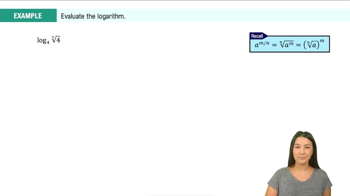
Basic Properties of Logarithms Example 1
73
views
1
rank
05:50
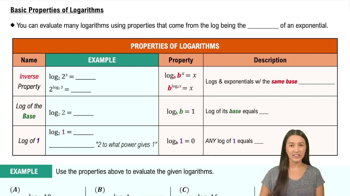
Basic Properties of Logarithms
84
views
04:20
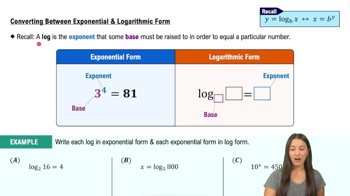
Converting Between Exponential & Logarithmic Form
82
views
1
rank
Terms in this set (15)
Hide definitions
Logarithmic Function
Inverse of an exponential, reveals the exponent needed for a base to reach a specific value.
Exponential Form
Expression where a base is raised to a power, often converted to logarithmic notation.
Logarithmic Notation
Format showing the exponent required for a base to equal a number, written as log base b of x.
Base
Number repeatedly multiplied in exponential and logarithmic expressions, crucial for conversions.
Exponent
Power indicating how many times the base is used as a factor; equals the logarithm in log form.
Argument
Value inside a logarithm, representing the result the base must reach when raised to the exponent.
Inverse Function
Function that reverses another, such as logarithmic undoing exponential operations.
Conversion
Process of rewriting expressions between exponential and logarithmic forms, focusing on base and exponent.
Inverse Property
Rule stating that logarithms and exponentials with the same base cancel, leaving the exponent.
Fractional Exponent
Exponent written as a fraction, often used to represent roots in logarithmic evaluations.
Negative Exponent
Exponent indicating reciprocal, useful for rewriting fractions in logarithmic expressions.
Root
Value that, when raised to a certain power, equals the argument; often rewritten as a fractional exponent.
Polynomial Degree
Highest exponent in a polynomial, connected to understanding exponents and logarithms.
Logarithmic Properties
Rules like log base b of b equals 1 and log base b of 1 equals 0, aiding in quick evaluations.
Function Notation
Symbolic representation of functions, such as f(x), used to express logarithmic and exponential relationships.