Intermediate Algebra
My Course
Learn
AI Tutor
Study Guides
Flashcards
Explore
Try the app
My Course
Learn
AI Tutor
Study Guides
Flashcards
Explore
Try the app
Back
Introduction to Logarithmic Functions quiz
You can tap to flip the card.
What is a logarithm in relation to an exponential function?
You can tap to flip the card.
👆
What is a logarithm in relation to an exponential function?
A logarithm is the exponent that a base must be raised to in order to equal a particular number; it is the inverse of an exponential function.
Track progress
Control buttons has been changed to "navigation" mode.
1/15
Related flashcards
Recommended videos
Introduction to Logarithmic Functions definitions
Introduction to Logarithmic Functions
15 Terms
01:22
Basic Properties of Logarithms Example 1
73
views
1
rank
05:50
Basic Properties of Logarithms
84
views
04:20
Converting Between Exponential & Logarithmic Form
82
views
1
rank
Terms in this set (15)
Hide definitions
What is a logarithm in relation to an exponential function?
A logarithm is the exponent that a base must be raised to in order to equal a particular number; it is the inverse of an exponential function.
How do you write the exponential equation 2^y = 10 in logarithmic form?
You write it as y = log base 2 of 10, or y = log₂(10).
What does the notation log_b(x) mean?
It means the exponent y such that b^y = x; b is the base and x is the argument.
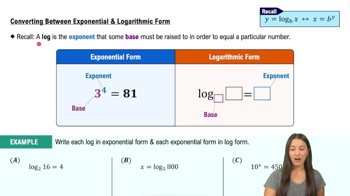
How are exponential and logarithmic forms related?
They are inverses: y = log_b(x) is equivalent to x = b^y.
What is the base in the logarithmic expression log_5(x)?
The base is 5.
How do you convert the logarithmic equation log_3(81) = 4 to exponential form?
You write it as 3^4 = 81.
What is the inverse function of f(x) = 5^x?
The inverse is f⁻¹(x) = log base 5 of x, or f⁻¹(x) = log₅(x).
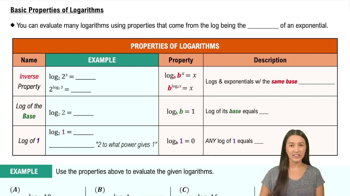
What is the value of log_2(2^3)?
It is 3, because the log and exponential with the same base cancel, leaving the exponent.
What is the value of log_b(b) for any base b?
It is always 1, because b^1 = b.
What is the value of log_b(1) for any base b?
It is always 0, because any base raised to the power of 0 equals 1.
How can you evaluate log_4(16) without a calculator?
Rewrite 16 as 4^2, so log_4(4^2) = 2.
How do you evaluate log_5(1/5) using exponent rules?
Rewrite 1/5 as 5^(-1), so log_5(5^(-1)) = -1.
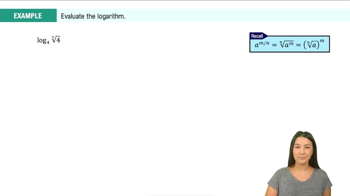
How do you rewrite the cube root of 4 as an exponent?
The cube root of 4 is 4^(1/3).
What is log_4(∛4) equal to?
It is 1/3, because log_4(4^(1/3)) = 1/3.
What two elements should you focus on when converting between exponential and logarithmic forms?
Focus on the base and the exponent, as they determine the structure of both forms.