Back

Introduction to Radical Expressions definitions

Control buttons has been changed to "navigation" mode.
1/15
  • Square Root

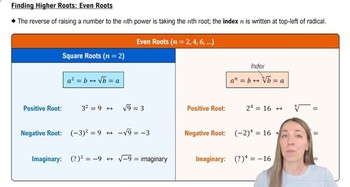
    A value that, when multiplied by itself, results in a given number; always two for positive real numbers.
  • Principal Root

    The positive value indicated by the radical symbol, representing the main solution for a square root.
  • Negative Root

    The negative value found by placing a minus sign before the radical symbol, representing the alternate solution.
  • Radical Symbol

    A notation used to indicate the square root operation, defaulting to the principal root unless modified.
  • Imaginary Number

    A value resulting from a negative number inside a radical, since no real number squared yields a negative.
  • Notation

    The specific way mathematical expressions are written to clarify which root or value is being referenced.
  • Exponent

    A mathematical expression indicating repeated multiplication, closely related to squaring and roots.
  • Polynomial

    An algebraic expression involving terms with exponents, often requiring evaluation with roots.
  • Standard Form

    A way of writing expressions to ensure clarity and proper evaluation, especially with roots and exponents.
  • Positive Real Number

    A value greater than zero, always yielding two square roots—one positive and one negative.
  • Negative Sign

    A symbol placed outside the radical to indicate the negative root, or inside to signal an imaginary result.
  • Plus-Minus Symbol

    A notation used to represent both positive and negative roots simultaneously in a compact form.
  • Solution

    A value that satisfies a mathematical equation, such as a root that squares to a given number.
  • Evaluation

    The process of determining the value of an expression, especially when working with roots and radicals.
  • Expression

    A combination of numbers, symbols, and operations, often involving roots, exponents, and polynomials.