Back

Introduction to Radical Expressions quiz

Control buttons has been changed to "navigation" mode.
1/15
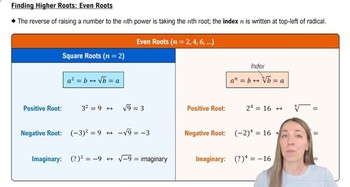
  • What is the relationship between squaring a number and taking its square root?

    Squaring and taking the square root are opposite operations; squaring a number gives a result, and taking the square root finds the original number.
  • What does the radical symbol (√) represent when written by itself?

    The radical symbol by itself represents the positive (principal) square root of a number.
  • How do you indicate the negative square root of a number using notation?

    You place a minus sign in front of the radical symbol to indicate the negative square root.
  • What are the square roots of 9?

    The square roots of 9 are 3 and -3.
  • Why does every positive real number have two square roots?

    Because both a positive and its negative, when squared, yield the same positive result.
  • What does the notation ±√9 mean?

    It means both the positive and negative square roots, so ±√9 = 3 and -3.
  • What is the value of √36?

    The value of √36 is 6, the positive square root.
  • What is the value of -√36?

    The value of -√36 is -6, the negative square root.
  • What happens if you try to take the square root of a negative number, like √-9?

    The result is not a real number; it is considered imaginary.
  • Why can't you find a real number whose square is negative?

    Because squaring any real number, positive or negative, always results in a positive value.
  • Is it correct to write √9 = ±3?

    No, √9 by itself means only the positive root, 3; to indicate both, use ±√9.
  • What does a negative sign outside the radical symbol indicate?

    It indicates the negative square root of the number under the radical.
  • What does a negative number inside the radical symbol indicate?

    It indicates an imaginary number, since no real number squared gives a negative result.
  • How do you evaluate √-36?

    √-36 is imaginary because there is no real number whose square is -36.
  • What is the principal root of a positive number?

    The principal root is the positive square root, represented by the radical symbol without a minus sign.