Intermediate Algebra
My Course
Learn
AI Tutor
Study Guides
Flashcards
Explore
Try the app
My Course
Learn
AI Tutor
Study Guides
Flashcards
Explore
Try the app
Back
Multiplying and Dividing Complex Numbers definitions
You can tap to flip the card.
Complex Number
You can tap to flip the card.
👆
Complex Number
A value combining a real part and an imaginary part, typically written in the form a+bi.
Track progress
Control buttons has been changed to "navigation" mode.
1/15
Related flashcards
Recommended videos
Multiplying and Dividing Complex Numbers quiz
Multiplying and Dividing Complex Numbers
15 Terms
05:02
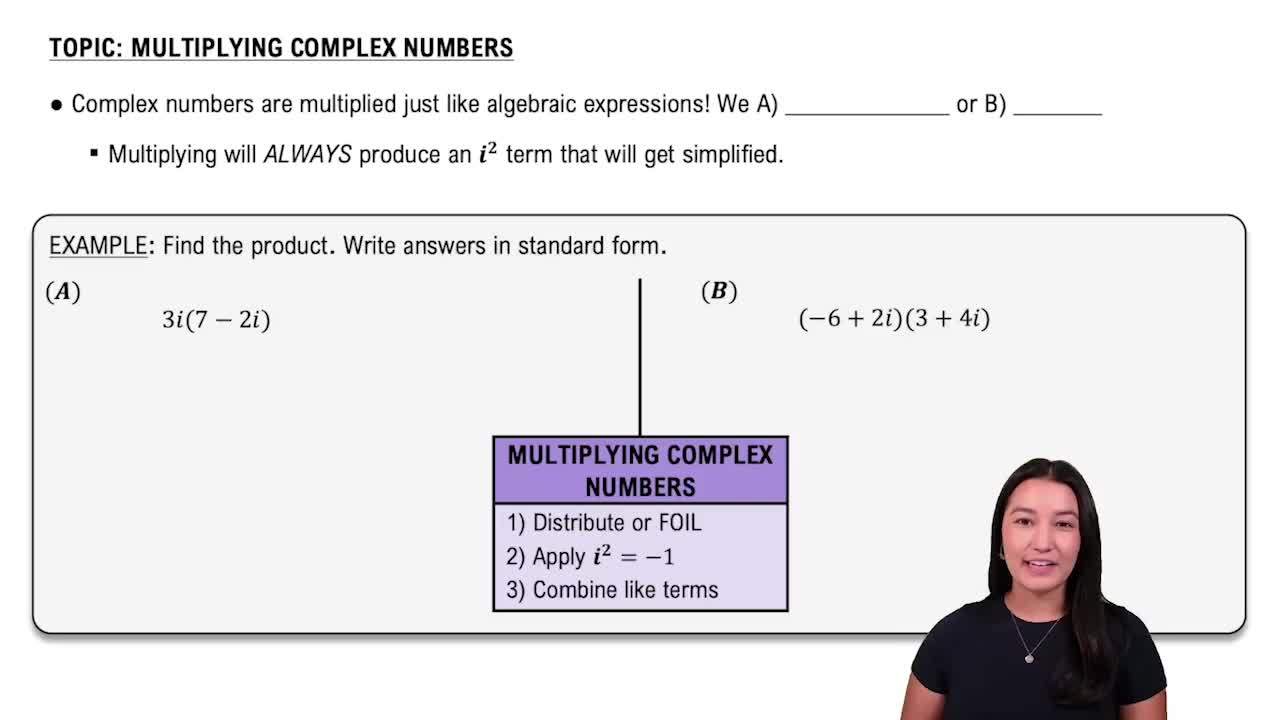
Multiplying Complex Numbers
79
views
1
rank
05:33
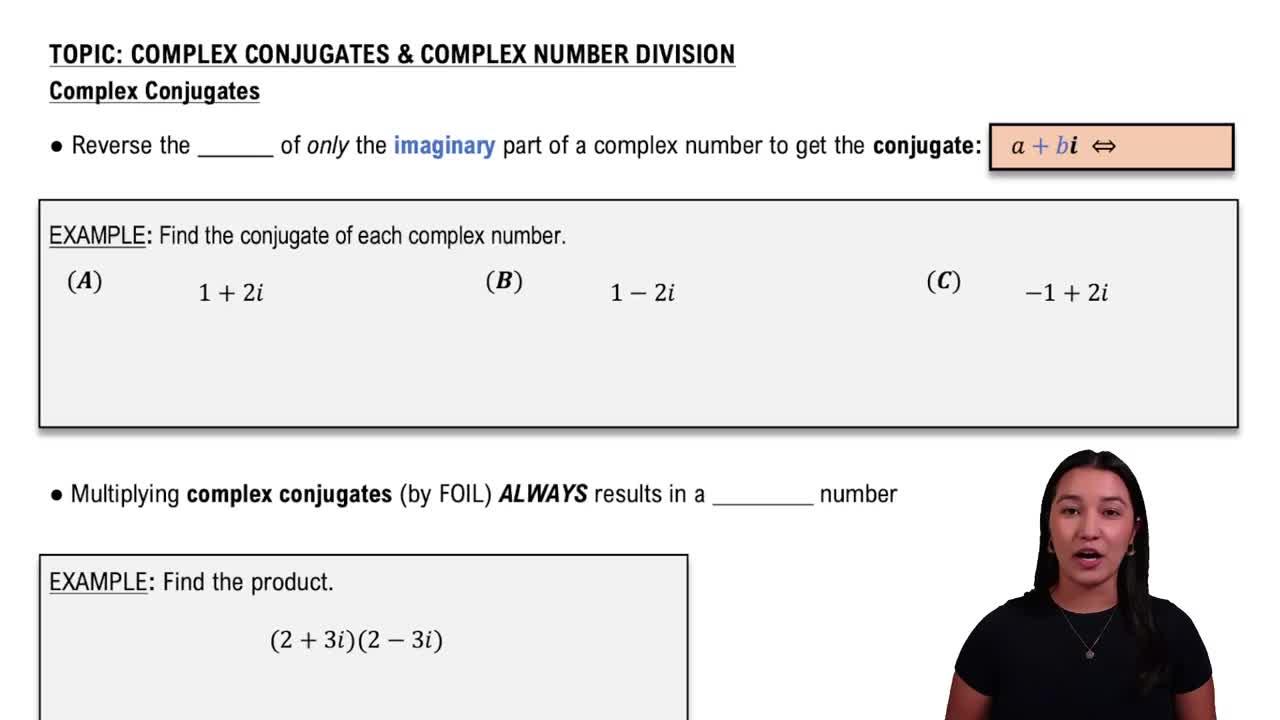
Complex Conjugates
64
views
1
rank
04:10
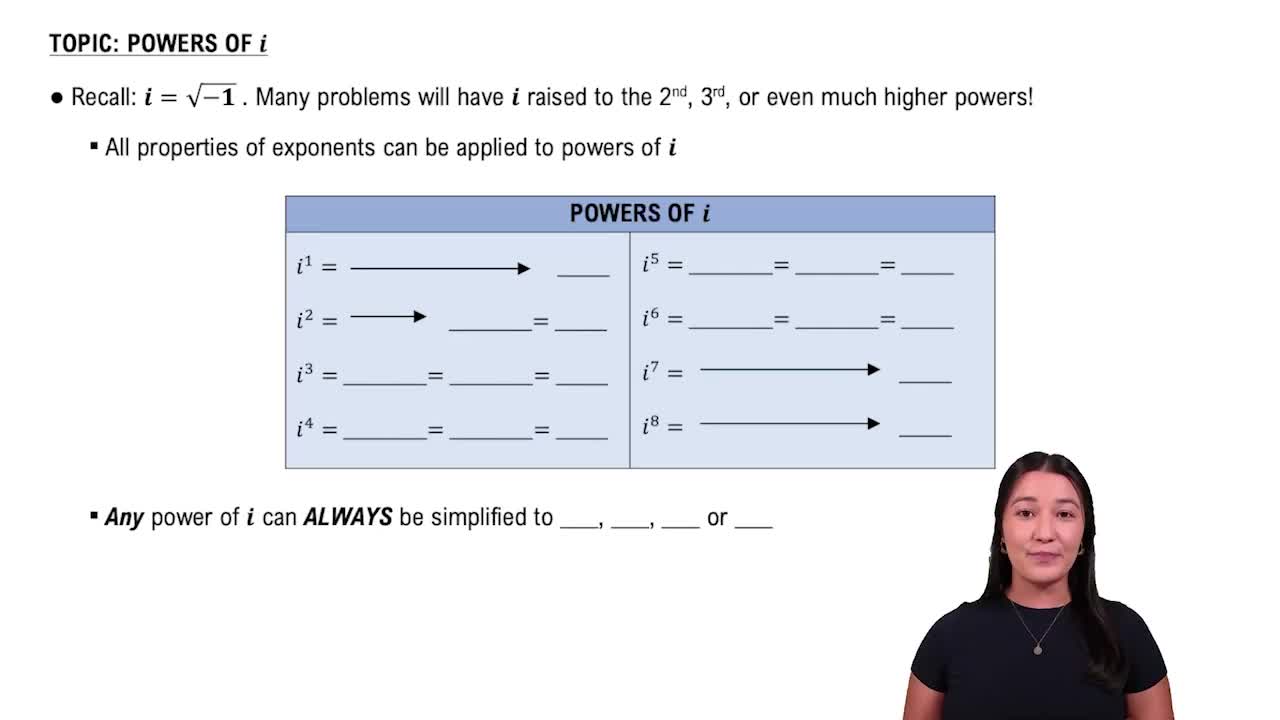
Powers of i
63
views
1
rank
Terms in this set (15)
Hide definitions
Complex Number
A value combining a real part and an imaginary part, typically written in the form a+bi.
Imaginary Unit
A symbol representing the square root of negative one, used to construct imaginary numbers.
Standard Form
An expression of a complex number as a+bi, with the real part first and the imaginary part second.
FOIL Method
A technique for multiplying two binomials, applying multiplication to first, outside, inside, and last terms.
Distribution
A process for multiplying a single term across terms inside parentheses, used in complex number multiplication.
I Squared
A value equal to negative one, crucial for simplifying products involving imaginary units.
Complex Conjugate
A value formed by reversing the sign of the imaginary part of a complex number, useful for division.
Real Part
The component of a complex number not multiplied by the imaginary unit, remaining unchanged in conjugation.
Imaginary Part
The component of a complex number multiplied by the imaginary unit, whose sign is reversed in conjugation.
Quotient Simplification
A process for expressing a division of complex numbers in lowest terms, separating real and imaginary components.
Powers of I
Values resulting from raising the imaginary unit to integer exponents, cycling through four distinct results.
Exponent Cycle
A repeating pattern in powers of the imaginary unit, with results recurring every four exponents.
Remainder
A value found by dividing an exponent by four, used to determine the simplified form of high powers of the imaginary unit.
Polynomial Operations
Procedures such as distribution and FOIL applied to expressions involving complex numbers.
Denominator Rationalization
A method for removing the imaginary unit from the denominator by multiplying by the complex conjugate.