Back

Multiplying, Dividing, and Rationalizing Radicals definitions

Control buttons has been changed to "navigation" mode.
1/15
  • Radical

    A symbol representing the root of a number, often used to denote square roots or higher-order roots.
  • Denominator

    The lower part of a fraction, indicating the number of equal parts the whole is divided into.
  • Numerator

    The upper part of a fraction, representing how many parts are being considered.
  • Perfect Square

    A number whose square root is a whole number, allowing radicals to be simplified easily.
  • Rational Number

    A value expressible as a fraction with integer numerator and denominator, free of radicals.
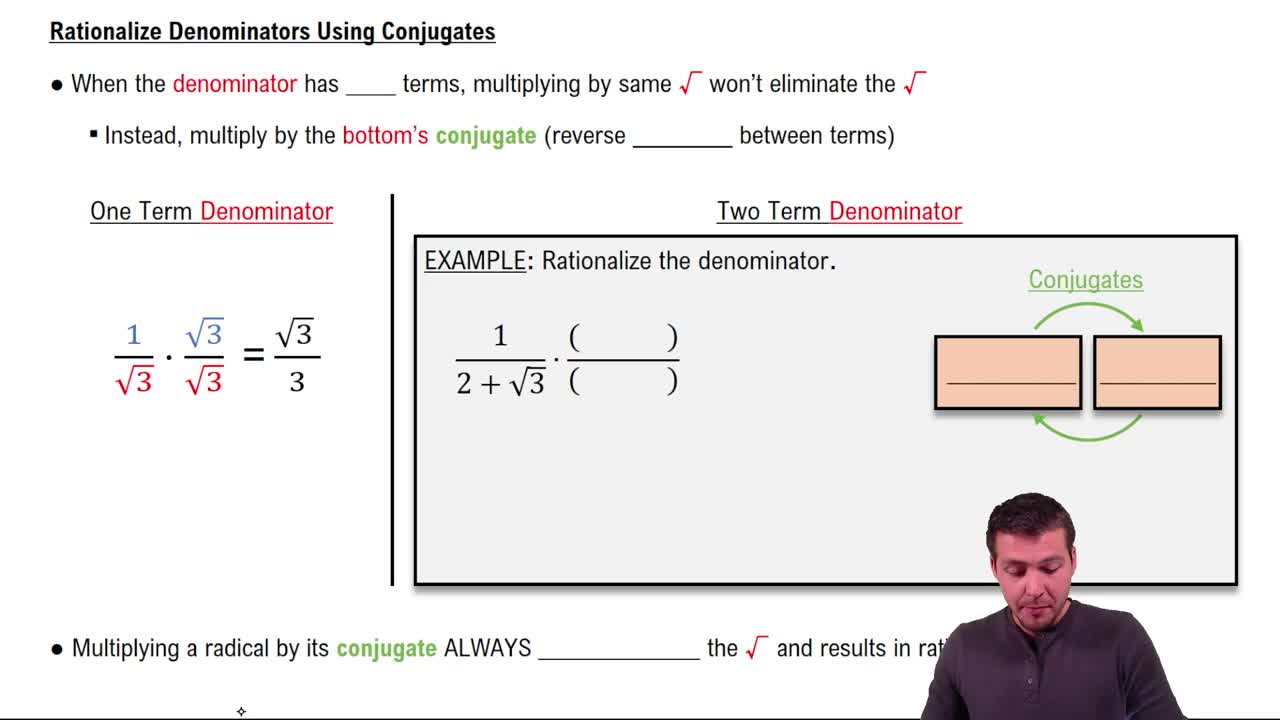
  • Conjugate

    A binomial formed by reversing the sign between two terms, used to eliminate radicals in denominators.
  • Binomial

    An algebraic expression containing exactly two terms, often seen in denominators needing rationalization.
  • Difference of Squares

    A formula resulting from multiplying conjugates, yielding a rational expression by removing radicals.
  • Fraction

    A mathematical expression representing division, often requiring rationalization when radicals appear below.
  • Expression

    A combination of numbers, variables, and operations, which may include radicals and require simplification.
  • Root

    A value that, when raised to a specific power, produces the original number, commonly shown with radical notation.
  • Square Root

    A specific root where the number is raised to the power of two, frequently encountered in rationalization.
  • Standard Form

    A simplified version of an expression, typically with a rational denominator and no radicals below.
  • Quotient

    The result of division, often requiring rationalization to ensure the denominator is rational.
  • Polynomial

    An expression with multiple terms, sometimes involving radicals that need rationalization for further operations.