Back

Multiplying, Dividing, and Rationalizing Radicals quiz

Control buttons has been changed to "navigation" mode.
1/15
  • What does it mean to rationalize the denominator of a fraction?

    It means to eliminate any radicals from the denominator so that the denominator is a rational number.
  • Why is it considered 'bad' to leave a radical in the denominator of a fraction?

    Because standard mathematical form requires denominators to be rational, not irrational or containing radicals.
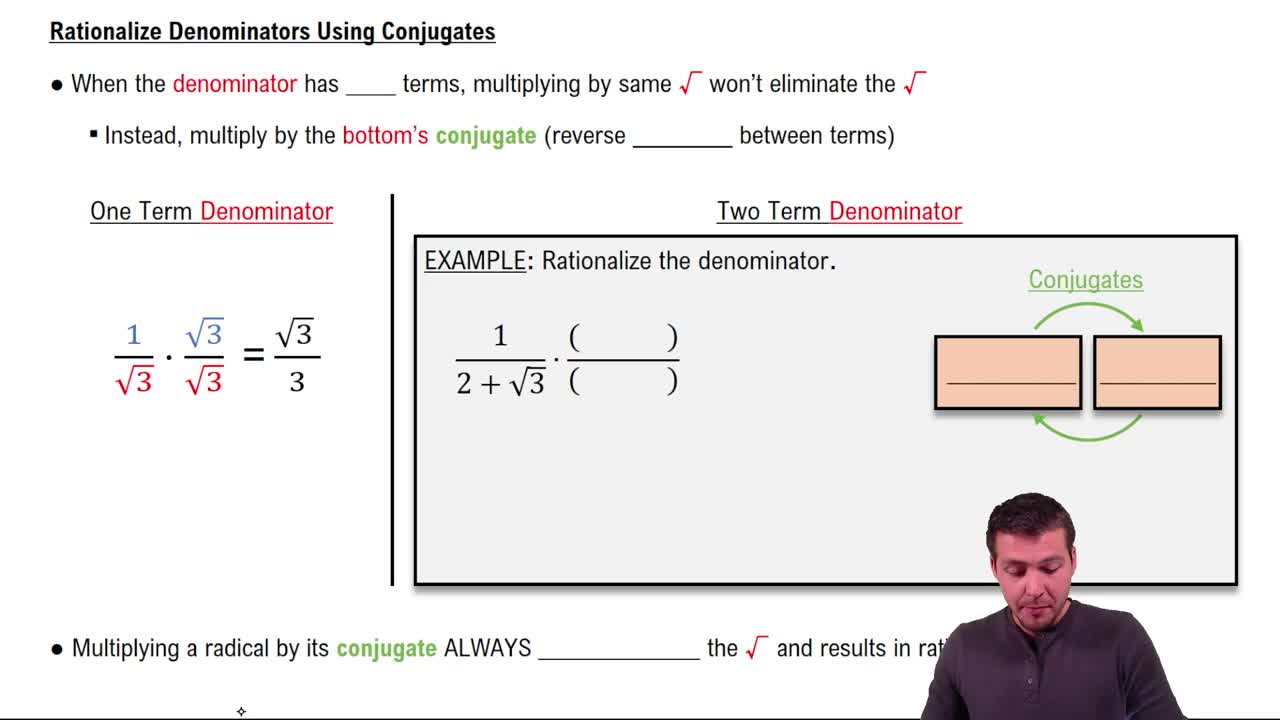
  • What do you multiply by to rationalize a denominator that is a single radical, like 1/√3?

    You multiply both the numerator and denominator by the same radical in the denominator, in this case √3.
  • What is the result of multiplying √3 by √3?

    The result is 3, because √3 × √3 = √9 = 3.
  • After rationalizing 1/√3, what is the new expression and why is it equivalent?

    The new expression is √3/3, and it is equivalent because both expressions have the same numerical value.
  • What is a conjugate in the context of rationalizing denominators?

    A conjugate is formed by changing the sign between two terms in a binomial, such as turning (2 + √3) into (2 - √3).
  • Why can't you simply multiply by the denominator itself when rationalizing a binomial denominator like 1/(2+√3)?

    Because multiplying by itself does not eliminate the radical; it leaves a radical in the denominator.
  • What do you multiply by to rationalize a denominator like 1/(2+√3)?

    You multiply both the numerator and denominator by the conjugate of the denominator, which is (2 - √3).
  • What mathematical property is used when multiplying a binomial by its conjugate?

    The difference of squares property is used, which eliminates the radical terms.
  • What is the general formula for the conjugate of (a + √b)?

    The conjugate is (a - √b).
  • What happens to the denominator when you multiply (2+√3) by its conjugate (2-√3)?

    The denominator becomes a rational number, specifically 4 - 3 = 1.
  • Is it acceptable to have a radical in the numerator after rationalizing the denominator?

    Yes, it is acceptable to have a radical in the numerator as long as the denominator is rational.
  • What is the result of rationalizing 1/(2+√3) by multiplying by its conjugate?

    The result is (2 - √3)/1, which simplifies to 2 - √3.
  • When rationalizing, why must you multiply both the numerator and denominator by the same value?

    To ensure the value of the expression does not change, as multiplying by a form of 1 preserves equivalence.
  • Summarize the two main methods for rationalizing denominators.

    For a single-term denominator, multiply by the radical; for a two-term denominator, multiply by its conjugate.