Skip to main content
Intermediate Algebra
My Course
Learn
Exam Prep
AI Tutor
Study Guides
Flashcards
Explore
Try the app
My Course
Learn
Exam Prep
AI Tutor
Study Guides
Flashcards
Explore
Try the app
Back
Percent Problem Solving definitions
You can tap to flip the card.
Percent
You can tap to flip the card.
👆
Percent
A part per hundred, often used to express ratios, fractions, or decimals in real-world contexts like scores or prices.
Track progress
Control buttons has been changed to "navigation" mode.
1/15
Related flashcards
Related practice
Recommended videos
Percent Problem Solving quiz
Percent Problem Solving
15 Terms
Percent Problem Solving
3. Solving Word Problems
5 problems
Topic
ErnestBlazevic
Mixture Problem Solving
3. Solving Word Problems
5 problems
Topic
ErnestBlazevic
3. Solving Word Problems
4 topics
12 problems
Chapter
ErnestBlazevic
Guided course
02:05
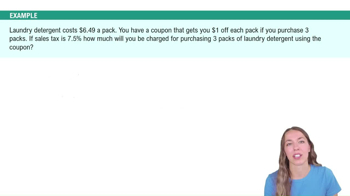
Translating Percent Problems Example 4
94
views
Guided course
06:10
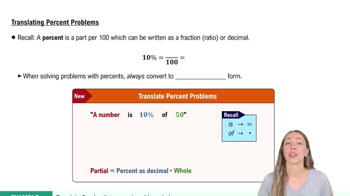
Translating Percent Problems
140
views
Guided course
02:39
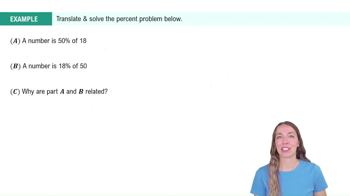
Translating Percent Problems Example 1
120
views
Terms in this set (15)
Hide definitions
Percent
A part per hundred, often used to express ratios, fractions, or decimals in real-world contexts like scores or prices.
Decimal
A numerical form used for calculations, obtained by dividing a percentage by 100 and shifting the decimal point left twice.
Fraction
A representation of a part of a whole, such as expressing 10% as 10 over 100.
Ratio
A comparison between two quantities, often used to relate partial amounts to whole amounts in percent problems.
Partial Amount
A value representing a portion of a whole, calculated by multiplying a percent (in decimal form) by the whole amount.
Whole Amount
The total value from which a partial amount is derived, often used as the base in percent calculations.
Percent Change
A measure of difference between two values, expressed as a percentage of the original value to show increase or decrease.
Percent Increase
A positive percent change, indicating growth or rise in value compared to the original amount.
Percent Decrease
A negative percent change, indicating reduction or drop in value compared to the original amount.
Discount
A reduction in price, calculated as a percent of the original price and subtracted to find the new price.
Markup
An increase in price, calculated as a percent of the original price and added to determine the new price.
Simple Interest
A charge for borrowing money, found by multiplying principal, interest rate (as decimal), and time.
Principal
The original amount of money borrowed or invested, used as the base in interest calculations.
Interest Rate
A percentage representing the cost of borrowing or return on investment, converted to decimal for calculations.
Time
The duration for which money is borrowed or invested, used in calculating simple interest.
 BackBack
 02:05
02:05