Back

Simplifying Exponential Expressions Using All Exponent Rules definitions

Control buttons has been changed to "navigation" mode.
1/15
  • Exponent Rules

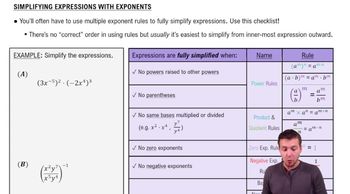
    Guidelines for manipulating powers, including multiplying, dividing, and raising powers to powers, to simplify expressions.
  • Power Rule

    When a power is raised to another power, multiply the exponents to combine them into a single exponent.
  • Product Rule

    When multiplying like bases, add their exponents to combine them into a single term.
  • Quotient Rule

    When dividing like bases, subtract the exponent in the denominator from the exponent in the numerator.
  • Negative Exponent

    Indicates a reciprocal; rewrite the expression so the exponent becomes positive by moving it across the fraction bar.
  • Reciprocal

    Flipping a fraction so the numerator becomes the denominator and vice versa, often used to handle negative exponents.
  • Numerical Coefficient

    A constant factor multiplied by a variable, which must be evaluated when simplifying expressions.
  • Parentheses

    Grouping symbols used to indicate which parts of an expression should be simplified first, often containing powers.
  • Like Bases

    Variables or numbers with the same base, allowing their exponents to be combined using exponent rules.
  • Standard Form

    An expression with no parentheses, no zero or negative exponents, and fully evaluated coefficients.
  • Polynomial Degree

    The highest exponent of a variable in a polynomial, indicating its complexity.
  • Innermost Expression

    The deepest grouping within parentheses, which should be simplified before moving outward.
  • Zero Exponent

    Any base raised to zero equals one, simplifying expressions by removing terms.
  • Term

    A single part of an expression, consisting of a coefficient and variables raised to exponents.
  • Simplified Expression

    An expression reduced to its most basic form, with all rules applied and no further simplification possible.