Back

Simplifying Fractions definitions

Control buttons has been changed to "navigation" mode.
1/15
  • Fraction

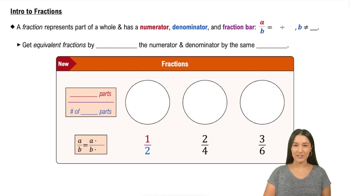
    Represents a part of a whole, shown with a numerator, denominator, and fraction bar, and relates to division.
  • Numerator

    Indicates the number of parts being considered out of the total divided by the denominator.
  • Denominator

    Shows the total number of equal parts the whole is divided into; must not be zero.
  • Fraction Bar

    Separates the numerator and denominator, visually representing division in a fraction.
  • Equivalent Fractions

    Different fractions that represent the same value, created by multiplying both parts by the same constant.
  • Proper Fraction

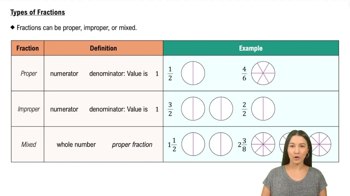
    Has a numerator less than the denominator, always representing a value less than one.
  • Improper Fraction

    Has a numerator greater than or equal to the denominator, always representing a value at least one.
  • Mixed Number

    Combines a whole number with a proper fraction, visually shown as shaded whole shapes plus fractional parts.
  • Lowest Terms

    A fraction form where numerator and denominator share no common factors, achieved by canceling the greatest common factor.
  • Greatest Common Factor

    The largest number that divides both numerator and denominator, used to simplify fractions.
  • Prime Factor

    A basic building block of numbers, used to break down numerators and denominators for simplification.
  • Visual Representation

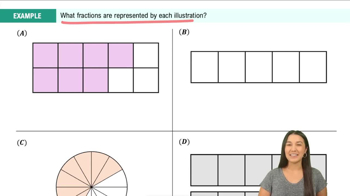
    Uses shapes divided and shaded to illustrate the value of fractions and their types.
  • Division

    The operation underlying fractions, where the numerator is divided by the denominator.
  • Common Factor

    A number that divides both numerator and denominator, allowing for simplification.
  • Constant

    A fixed value used to multiply both numerator and denominator to create equivalent fractions.