Back

Simplifying Fractions quiz

Control buttons has been changed to "navigation" mode.
1/15
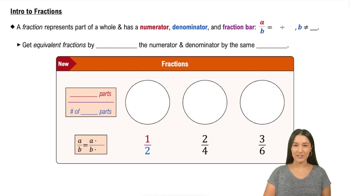
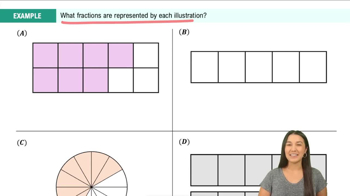
  • What does the denominator of a fraction tell you when representing it visually?

    The denominator tells you into how many equal parts to divide the shape representing the whole.
  • Why can't the denominator of a fraction be zero?

    Because dividing by zero is undefined, and you cannot split a whole into zero parts.
  • How do you create an equivalent fraction from a given fraction?

    Multiply both the numerator and the denominator by the same nonzero constant.
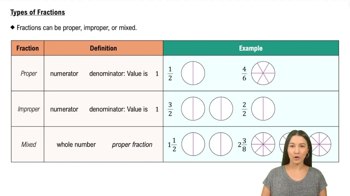
  • What is a proper fraction?

    A proper fraction has a numerator less than its denominator, so its value is always less than one.
  • Give an example of an improper fraction and explain why it is improper.

    Three over two (3/2) is improper because the numerator (3) is greater than the denominator (2).
  • What is a mixed number?

    A mixed number combines a whole number and a proper fraction, such as 1 and 1/2.
  • How do you simplify a fraction to lowest terms?

    Factor the numerator and denominator and cancel out their greatest common factor.
  • What does it mean for a fraction to be in lowest terms?

    It means the numerator and denominator have no common factors other than one.
  • If a fraction's numerator and denominator are the same, what is its value?

    The value is one, because any number divided by itself equals one.
  • What is the value of a proper fraction compared to one?

    A proper fraction is always less than one.
  • What is the value of an improper fraction compared to one?

    An improper fraction is always greater than or equal to one.
  • How can you check if a fraction is already in lowest terms?

    Factor both the numerator and denominator; if they have no common factors, the fraction is in lowest terms.
  • What is the process for simplifying a fraction like 80/60?

    Divide both numerator and denominator by their greatest common factor (10), then repeat with any remaining common factors until none remain.
  • What does multiplying the numerator and denominator by the same number do to a fraction?

    It creates an equivalent fraction with the same value as the original.
  • Why might you need more than one shape to represent an improper fraction visually?

    Because the numerator is greater than the denominator, so you need more than one whole to shade the required number of parts.